Zalud House

Why it's listed
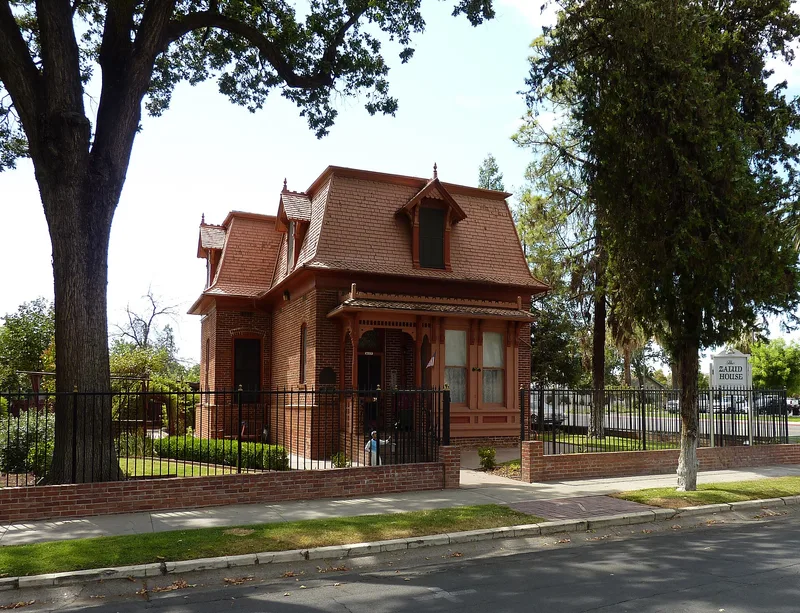
Built in 1891 at 393 North Hockett Street in Porterville, this one and one-half story brick house shows the Second Empire style through its mansard roof, ornate dormers with triangular pediments, and finely detailed wood porch. Its double brick walls with an air space were designed to suit San Joaquin Valley weather. Brick is an uncommon material for this style, and the house is the only Second Empire building in town. John Zalud, a Bohemian immigrant who ran a saloon on Main Street and accumulated ranch land, commissioned Hugh and John Templeton to build it. His daughter Pearle lived there until 1970 and left it to the city. Since 1977 it has operated as a museum with largely original family furnishings, a rosewood fireplace inset carved in China, and landscaped gardens. A carriage house and stable remain on the lot, and the property is virtually unaltered.
Significance in brief: The nomination argues the house is significant mainly for its architecture. It is the only Second Empire building in Porterville and is considered the finest nineteenth century residence there. It is also unusual for being built of brick, since wood is the material usually favored in this style, and it has a very high level of integrity.
Machine-generated summary. This summary was generated by a language model from the official nomination document and has not been reviewed line by line by an editor. It may contain errors. Check the source document before relying on any detail. Source: nomination document (PDF) · National Archives catalog entry. NRHP reference 86003681, listed March 31, 1987. Summary generated October 2026 (model claude-sonnet-5-5, prompt v1.0-2026-10-29, confidence medium).
Key facts
| Address | 393 N. Hockett St., Porterville |
|---|---|
| County | Tulare County |
| Listed | March 31, 1987 |
| Reference number | 86003681 |
| Resource type | Building |
| Period of significance | 1800-1899 |
| Architect / builder | Hugh and John Templeton (brickwork by John Leach) |
| Architectural style | Second Empire |
| Areas of significance | Architecture |
| Level of significance | Local |
| Status (as stated in the nomination) | Occupied and in use as a city-owned museum, which opened in 1977; condition is listed as excellent and virtually unaltered. |
| Acreage | 0.3 |
| Within district | Big Creek Hydroelectric System Historic District |
| Coordinates | 36.07255, -119.01642 (NPS GIS) |
What listing means for this property
National Register listing is honorary for a privately owned home: it does not by itself restrict what an owner may do with their own money, and it does not require public access. Restrictions come from local landmark or historic-district ordinances, which are separate (how they differ).
Owner-occupied houses are not eligible for the 20% federal rehabilitation tax credit, which applies to income-producing buildings, but many states offer credits for homeowners. Listing also opens the door to preservation easements and to buying a plaque. Start with what listing means for homeowners, renovating a listed house and selling one.
General information, not legal or tax advice. Rules change; confirm with your State Historic Preservation Office or a qualified adviser.
Sources and further reading
- National Park Service, National Register of Historic Places database (snapshot May 2026), reference 86003681.
- Nomination form (PDF, National Archives) — catalog entry
- Wikipedia article (used for cross-checking only; text not reproduced here)
- Wikidata Q14684283
- This listing as JSON
Last updated October 2026. Found an error? See the editorial policy for how to report it.