First Congregational Church
Also known as: United Church of Christ

Why it's listed
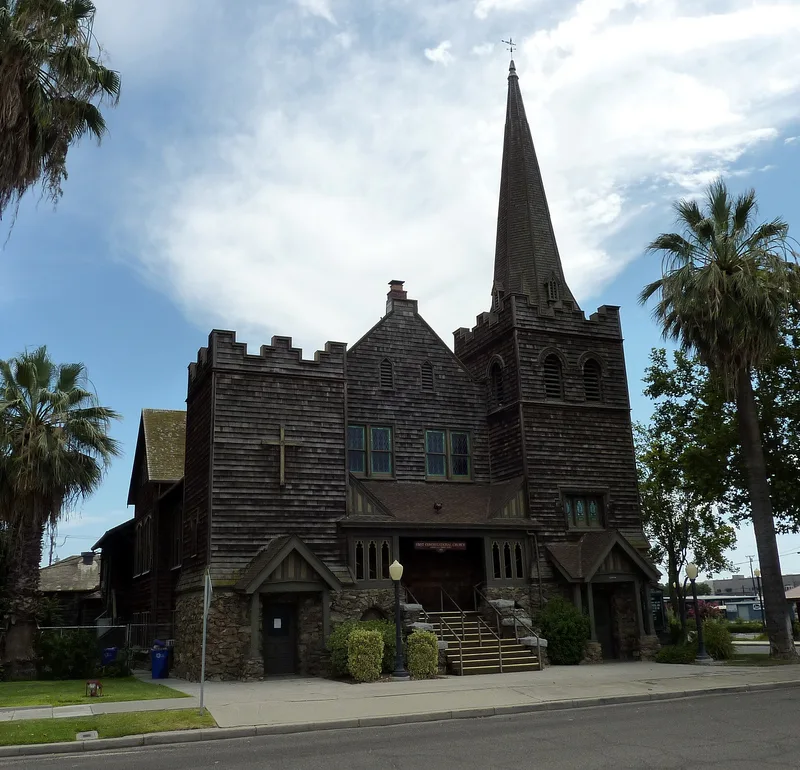
Completed in 1908 on a three-lot site that town founder Porter Putnam set aside for a church in 1864, this wood-frame building at Mill and Fourth Streets in Porterville was designed by Bay Area architects George C. Meeker and Francis W. Reed. It was planned as an Institutional Church, serving the whole community rather than only its members. The original design included an auditorium, a sunken meeting room, an indoor swimming tank and a second-floor gymnasium. Over the years it hosted a kindergarten, silent movies, lectures, recitals and Boy Scout meetings. Church-owned recreation facilities preceded comparable public ones in the area by a decade or more. A 1936 fire destroyed the south end, including the gymnasium, which was not rebuilt; the rest was restored as it had been. The exterior combines local stone with cedar shingles, and the paneled interior has stained glass windows showing oranges and citrus leaves. The nomination calls it the only building of its style and scale in the southern San Joaquin Valley.
Significance in brief: The nomination argues it is significant under Criterion A as an 'Institutional Church' that served as a social, cultural, recreational and educational center for Porterville and southern Tulare County from 1908 to 1936. It also meets Criterion C as the only example of Shingle/Bay Area Traditional design in Gothic Revival style on this scale in California's San Joaquin Valley.
Machine-generated summary. This summary was generated by a language model from the official nomination document and has not been reviewed line by line by an editor. It may contain errors. Check the source document before relying on any detail. Source: nomination document (PDF) · National Archives catalog entry. NRHP reference 98001553, listed January 5, 1999. Summary generated October 2026 (model claude-sonnet-5-5, prompt v1.0-2026-10-29, confidence high).
Key facts
| Address | 165 E. Mill St., Porterville |
|---|---|
| County | Tulare County |
| Listed | January 5, 1999 |
| Reference number | 98001553 |
| Resource type | Building |
| Period of significance | 1908 - 1936 |
| Architect / builder | Meeker, George C.; Reed, Francis W. (San Francisco Bay Area architects) |
| Architectural style | 19th century Late Gothic Revival; Shingle Style; other: Bay Area Tradition |
| Criteria |
|
| Areas of significance | Social History, Architecture |
| Level of significance | Local |
| Status (as stated in the nomination) | Described as in excellent condition, with interior and exterior looking much as they did 90 years earlier; still used for religious, meeting, education and music purposes. |
| Acreage | 0.4 |
| Within district | Big Creek Hydroelectric System Historic District |
| Coordinates | 36.06851, -119.01276 (NPS GIS) |
What listing means for this property
Religious properties are listed for their architectural or historical significance, not their religious use. Listing is honorary and does not restrict the congregation's use of the building. The federal rehabilitation credit is generally unavailable unless part of the building is income-producing; some state programmes and preservation grants do cover religious buildings. Federal funding or permits trigger Section 106 review.
General information, not legal or tax advice. Rules change; confirm with your State Historic Preservation Office or a qualified adviser.
Sources and further reading
- National Park Service, National Register of Historic Places database (snapshot May 2026), reference 98001553.
- Nomination form (PDF, National Archives) — catalog entry
- Wikipedia article (used for cross-checking only; text not reproduced here)
- Wikidata Q5452815
- This listing as JSON
Last updated October 2026. Found an error? See the editorial policy for how to report it.