NIANTIC (Storeship)
Also known as: Bow and Associated Material Culture, NIANTIC Storeship Site

Why it's listed
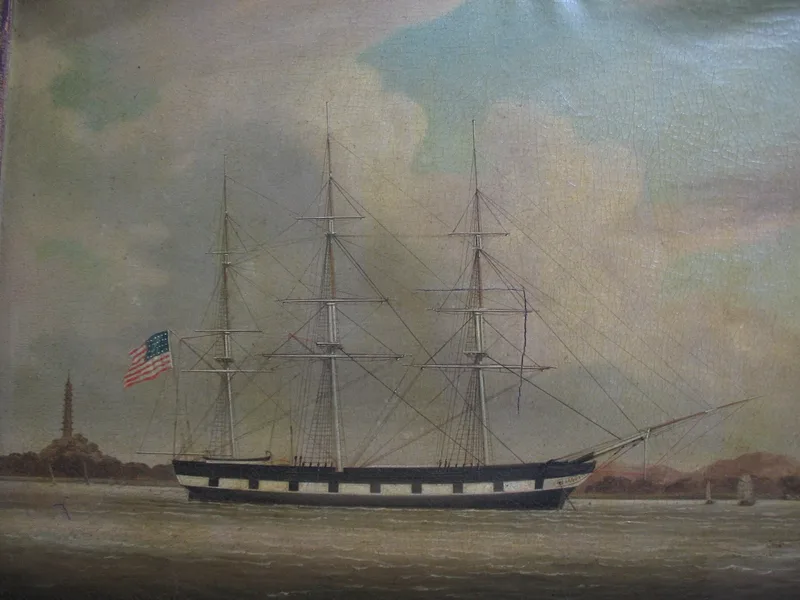
Beneath a lot at Clay and Sansome Streets in San Francisco lies the buried bow of Niantic, a ship built in 1835 by Thomas Childs in Connecticut. She served in the China trade and as a whaler, then carried 250 gold seekers from Panama to San Francisco in 1849. Her crew left for the mines, and merchants bought her, beached her on the waterfront, and turned her into a storeship with warehouses below and offices on deck. She was the first such conversion, followed by roughly 150 others. A fire in May 1851 burned her to the waterline, and the hull was later buried under fill. Construction in 1978 exposed about 90 feet of the hull, and crews recovered thousands of artifacts now held by the National Park Service. About 29 feet of the bow, thought to contain an intact deposit of goods, remains unexcavated. The site is valued for Gold Rush commerce, maritime history and archeology.
Significance in brief: Niantic was the first ship converted into a beached storeship on the San Francisco waterfront during the Gold Rush, paving the way for about 150 others. Its recovered artifacts are the only excavated and preserved Gold Rush storeship assemblage. The remaining bow is believed to hold about two-thirds of the artifact deposit, and the hull also records early 19th century American wooden shipbuilding.
Machine-generated summary. This summary was generated by a language model from the official nomination document and has not been reviewed line by line by an editor. It may contain errors. Check the source document before relying on any detail. Source: nomination document (PDF) · National Archives catalog entry. NRHP reference 91000563, listed May 16, 1991. Summary generated October 2026 (model claude-sonnet-5-5, prompt v1.0-2026-10-29, confidence high).
Key facts
| Address | NW corner of Clay and Sansome Sts., San Francisco |
|---|---|
| County | San Francisco |
| Listed | May 16, 1991 |
| Reference number | 91000563 |
| Resource type | Site |
| Period of significance | 1835-1851 |
| Architect / builder | Childs, Thomas (builder) |
| Criteria |
|
| Areas of significance | Commerce, Historic - Non-Aboriginal, Maritime History |
| Level of significance | National |
| Status (as stated in the nomination) | Current function is listed as vacant, not in use; the remaining bow lies buried beneath an adjacent lot. |
| Acreage | 0.1 |
| Coordinates | 37.79516, -122.40115 (NPS GIS) |
What listing means for this property
Sites (archaeological sites, battlefields, landscapes) are often listed with a restricted address to protect them from looting or disturbance. Listing is honorary for private owners; federal undertakings on or near the site go through Section 106 review, and state laws may protect burials and artefacts regardless of listing.
Noted as vacant in the nomination. Nomination documents can be decades old; current status may differ. If you are considering buying an empty listed property, read the due-diligence checklist.
General information, not legal or tax advice. Rules change; confirm with your State Historic Preservation Office or a qualified adviser.
Sources and further reading
- National Park Service, National Register of Historic Places database (snapshot May 2026), reference 91000563.
- Nomination form (PDF, National Archives) — catalog entry
- Wikipedia article (used for cross-checking only; text not reproduced here)
- Wikidata Q7024076
- This listing as JSON
Last updated October 2026. Found an error? See the editorial policy for how to report it.