Heilman Villas
Also known as: Babcock Court

Why it's listed
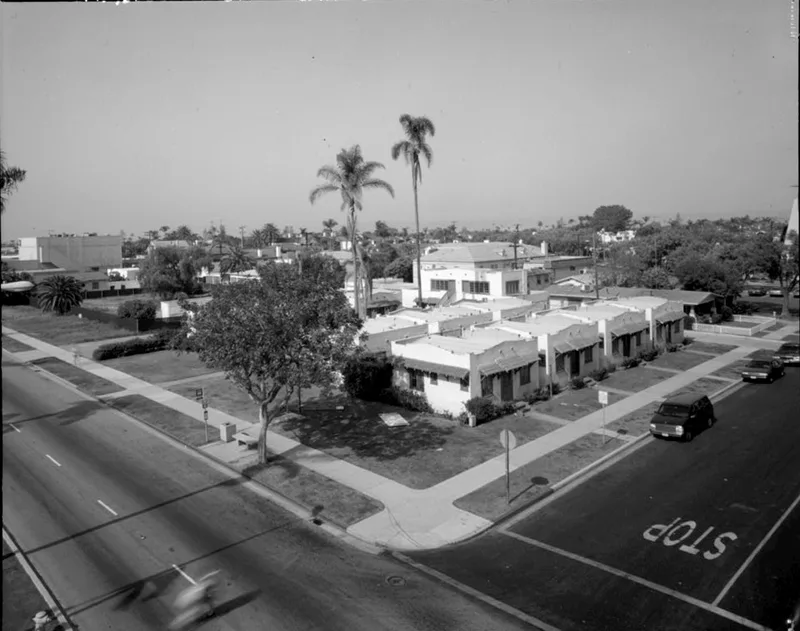
Eleven small buildings gather around a landscaped courtyard just off Orange Avenue in Coronado, forming a bungalow court completed in 1922 by builder Robert Heilman. Ten one-story bungalows, each with its own entry canopy of terra cotta tile, flank the court and a larger two-story building closes the rear. Walls are smooth stucco with crenellated parapets, wood casement windows and arched leaded-glass windows, and the interiors keep built-in desks, cabinets, display alcoves and fireplaces. Only the two-story building was altered significantly, when it became four flats in 1952 as the complex turned into a motel. The court is described as one of just two true bungalow courts in Coronado and as a nearly pristine example of a vanished building type that expresses the Craftsman-era ideal of shared outdoor living. The City bought the property in 1973 and later named it Babcock Court. It was recorded as vacant at the time of listing.
Significance in brief: The nomination argues the court is a classic, nearly pristine example of a Bungalow Court, a building type no longer built, and one of only two in Coronado. Its Spanish Colonial Revival/Pueblo design is described as an almost miniaturist, fully developed rendition with strong repetition of form and detailing. It also reflects Southern California's 1920s bungalow-court lifestyle and later use as a motel and civic headquarters.
Machine-generated summary. This summary was generated by a language model from the official nomination document and has not been reviewed line by line by an editor. It may contain errors. Check the source document before relying on any detail. Source: nomination document (PDF) · National Archives catalog entry. NRHP reference 92000319, listed April 8, 1992. Summary generated October 2026 (model claude-sonnet-5-5, prompt v1.0-2026-10-29, confidence high).
Key facts
| Address | 1060, 1070, 1080, 1090 Seventh St. and 706--720 (even nos.) Orange Ave., Coronado |
|---|---|
| County | San Diego County |
| Listed | April 8, 1992 |
| Reference number | 92000319 |
| Resource type | District |
| Period of significance | 1922 |
| Architect / builder | Heilman, Robert, builder |
| Architectural style | Mission/Spanish Colonial Revival; Pueblo |
| Criteria |
|
| Areas of significance | Architecture |
| Level of significance | Local |
| Status (as stated in the nomination) | Historic use was multiple dwelling; converted to a motel in 1952 (later called Coromar), then used by city organizations after the City purchased it in 1973. The form lists current use as vacant/not in use, and notes the city council recently evacuated the bungalows. |
| Acreage | 4 |
| Coordinates | 32.69010, -117.17784 (NPS GIS) |
What listing means for this property
This is a historic district. Buildings within its boundary are either contributing (they add to the district's significance) or non-contributing. Owners of contributing income-producing buildings can claim the 20% federal rehabilitation tax credit; homeowners should look at state credits. National Register districts impose no design review by themselves; a local historic district ordinance, if one exists, does (the difference explained).
Noted as vacant in the nomination. Nomination documents can be decades old; current status may differ. If you are considering buying an empty listed property, read the due-diligence checklist.
General information, not legal or tax advice. Rules change; confirm with your State Historic Preservation Office or a qualified adviser.
Sources and further reading
- National Park Service, National Register of Historic Places database (snapshot May 2026), reference 92000319.
- Nomination form (PDF, National Archives) — catalog entry
- Wikipedia article (used for cross-checking only; text not reproduced here)
- Wikidata Q9002390
- This listing as JSON
Last updated October 2026. Found an error? See the editorial policy for how to report it.