Mission San Juan Capistrano

Why it's listed
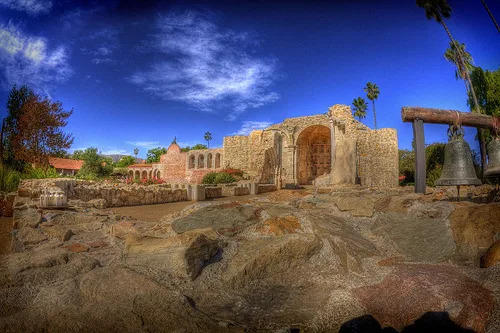
Mission San Juan Capistrano is a Franciscan mission complex in Orange County, California, built in nearly continuous stages between 1777 and 1817. Most buildings are adobe and are arranged around a quadrangle. The east side holds the chapel known as Serra's Church, the south side the padres' living quarters, kitchens and a detention room, and the north side a former warehouse now used as a convent and classrooms. The workshops and hospital on the west side survive as ruins, as does a large stone church completed in 1806 and destroyed by earthquake in 1812. Father Junipero Serra founded the mission in 1776 and dedicated the adobe chapel in 1778. That chapel is the only surviving church where he celebrated Mass. The mission also served as an industrial center, with 36 adobe rooms by 1812, including granaries and tanning, candle-making and spinning workshops. Mexico expropriated it in the early 1840s, and it returned to church ownership in 1865. Restoration began in 1900 and continues.
Significance in brief: The nomination presents it as the seventh mission in Alta California's chain, founded in 1776 by Padre Junipero Serra. Its adobe chapel is the only church still standing in which Serra celebrated Mass. The complex was also an industrial center with workshops, granaries and a hospital, and it was a significant center of early Southern California culture.
Machine-generated summary. This summary was generated by a language model from the official nomination document and has not been reviewed line by line by an editor. It may contain errors. Check the source document before relying on any detail. Source: nomination document (PDF) · National Archives catalog entry. NRHP reference 71000170, listed September 3, 1971. Summary generated October 2026 (model claude-sonnet-5-5, prompt v1.0-2026-10-29, confidence medium).
Key facts
| Address | Camino Capistrano and Ortega Hwy., San Juan Capistrano |
|---|---|
| County | Orange County |
| Listed | September 3, 1971 |
| Reference number | 71000170 |
| Resource type | Building |
| Areas of significance | Historic - Non-Aboriginal, Architecture, Religion |
| Level of significance | State |
| Status (as stated in the nomination) | Described as in good condition in part, with restoration begun by the Landmarks Club in 1900 and continued by the Church. The chapel is used for services, and the grounds are open for public tours. The stone church and the workshops and hospital are ruins. |
| Acreage | 5.8 |
| Coordinates | 33.50293, -117.66270 (NPS GIS) |
What listing means for this property
National Register listing is honorary: it recognises significance and does not restrict what a private owner may do without federal money or permits. It unlocks the 20% federal rehabilitation tax credit for income-producing buildings, state credits in many states, and Section 106 review when federal agencies are involved. See what listing means in practice.
General information, not legal or tax advice. Rules change; confirm with your State Historic Preservation Office or a qualified adviser.
Sources and further reading
- National Park Service, National Register of Historic Places database (snapshot May 2026), reference 71000170.
- Nomination form (PDF, National Archives) — catalog entry
- Wikipedia article (used for cross-checking only; text not reproduced here)
- Wikidata Q1939057
- This listing as JSON
Last updated October 2026. Found an error? See the editorial policy for how to report it.