Los Rios Street Historic District

Why it's listed
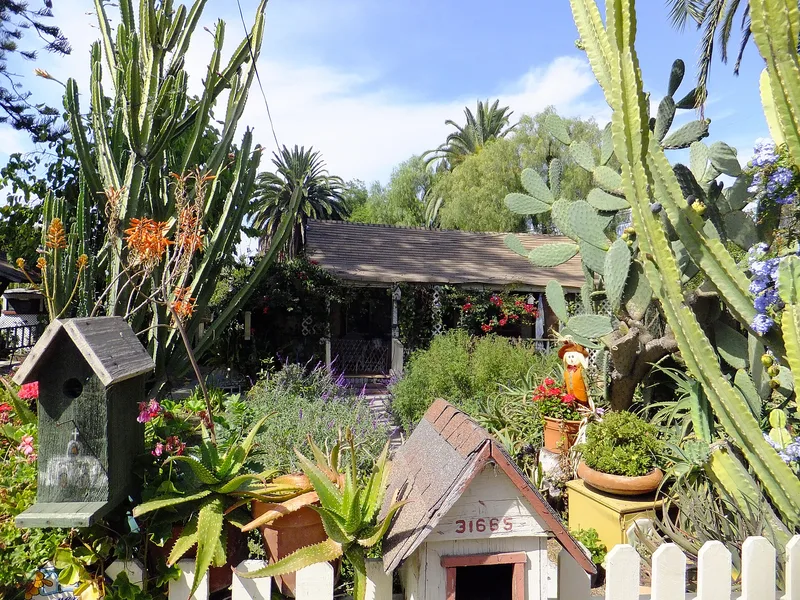
Los Rios Street in San Juan Capistrano is a four-block residential district between Del Obispo and Mission Streets, believed to be one of the oldest residential streets in California. It probably became a street in 1794, when about 40 adobe dwellings were built outside the Mission quadrangle to house Indian neophytes. Three of those adobes remain: the Montanez, Rios and Silvas adobes. The district holds thirty-one historic structures, most of them small board-and-batten homes built between about 1887 and 1910. It also includes a Victorian house built by the Labat brothers before 1887, the Pryor house, and the 1894 Mission style Santa Fe Depot. One house is believed to have come from the abandoned town of Forster. The nomination also stresses the community itself. Many residents trace their families in the area back six or seven generations, and neighbors help each other with repairs, gardens and the care of children and elders.
Significance in brief: The nomination argues Los Rios Street is believed to be one of the oldest residential streets in California, tied to the 1794 adobes built to house mission neophytes. Three adobes survive, along with Victorian homes and board-and-batten houses that show the area's settlement history. It is also described as a cohesive community where families have lived for six or seven generations.
Machine-generated summary. This summary was generated by a language model from the official nomination document and has not been reviewed line by line by an editor. It may contain errors. Check the source document before relying on any detail. Source: nomination document (PDF) · National Archives catalog entry. NRHP reference 83001216, listed April 4, 1983. Summary generated October 2026 (model claude-sonnet-5-5, prompt v1.0-2026-10-29, confidence medium).
Key facts
| Address | 31600-31921 Los Rios St., San Juan Capistrano |
|---|---|
| County | Orange County |
| Listed | April 4, 1983 |
| Reference number | 83001216 |
| Resource type | District |
| Period of significance | 1800-1899 |
| Architectural style | Vernacular, mainly board-and-batten, with adobe, Victorian and Mission style buildings |
| Areas of significance | Exploration/Settlement, Architecture, Social History |
| Level of significance | Local |
| Status (as stated in the nomination) | Condition is marked good to fair and altered. Most structures are occupied private residences. Two structures (14 and 16) are noted as destroyed, and the Santa Fe Depot was rehabilitated in 1974. |
| Acreage | 6.2 |
| Coordinates | 33.50162, -117.66449 (NPS GIS) |
What listing means for this property
This is a historic district. Buildings within its boundary are either contributing (they add to the district's significance) or non-contributing. Owners of contributing income-producing buildings can claim the 20% federal rehabilitation tax credit; homeowners should look at state credits. National Register districts impose no design review by themselves; a local historic district ordinance, if one exists, does (the difference explained).
General information, not legal or tax advice. Rules change; confirm with your State Historic Preservation Office or a qualified adviser.
Sources and further reading
- National Park Service, National Register of Historic Places database (snapshot May 2026), reference 83001216.
- Nomination form (PDF, National Archives) — catalog entry
- Wikipedia article (used for cross-checking only; text not reproduced here)
- Wikidata Q6683240
- This listing as JSON
Last updated October 2026. Found an error? See the editorial policy for how to report it.