Henessey, Dr. Edwin, House

Why it's listed
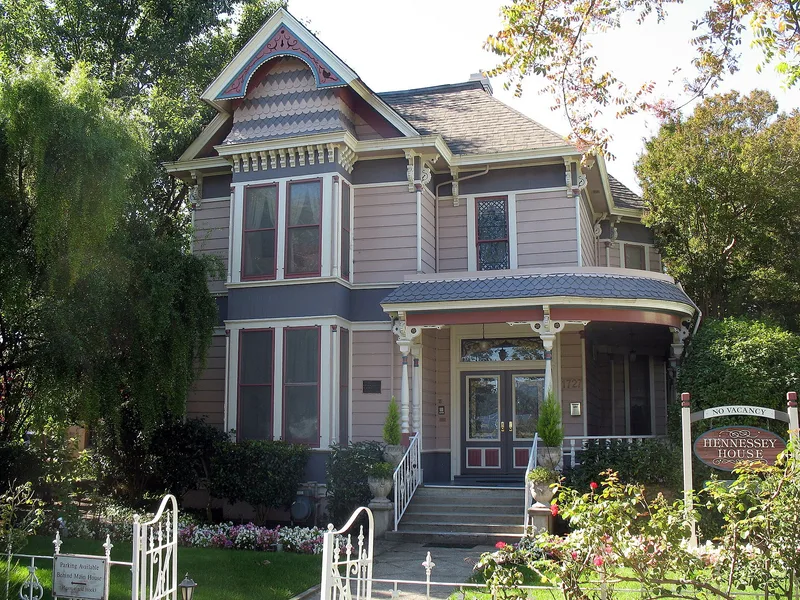
Built in 1889, this two-story wood frame house at 1727 Main Street in Napa shows the Stick-Eastlake style. Its features include a square front bay with a projecting gable and pierced bargeboard, bays on three sides, and a heavy wrap-around porch with turned posts and pierced brackets, added about 1901. Inside, a first-floor game room has hand-painted floral designs on pressed tin walls and ceiling, along with an original art glass light fixture. A two-story carriage house stands behind the residence. The house was designed by M. E. Johnson and is one of very few formal Victorian homes left near the edge of the old downtown. It is also linked to Dr. Edwin Hennessey, who came to Napa in 1886, served as County Physician from 1889, and was appointed physician of the Yountville Veterans Home in 1896. In 1897 he experimented with the x-ray, locating gems in rocks and a bullet lodged behind a man's jaw. Later changes, such as the enclosed rear porch and concrete front steps, are judged not to harm its integrity.
Significance in brief: The nomination argues local significance in architecture and science. The house is a good local example of Stick-Eastlake residential design and one of very few formal Victorian homes left in its neighborhood. It is also tied to Dr. Edwin Hennessey, a prominent Napa physician and long-time County Physician who experimented with the x-ray in the 1890s.
Machine-generated summary. This summary was generated by a language model from the official nomination document and has not been reviewed line by line by an editor. It may contain errors. Check the source document before relying on any detail. Source: nomination document (PDF) · National Archives catalog entry. NRHP reference 86001976, listed August 28, 1986. Summary generated October 2026 (model claude-sonnet-5-5, prompt v1.0-2026-10-29, confidence high).
Key facts
| Address | 1727 Main St., Napa |
|---|---|
| County | Napa County |
| Listed | August 28, 1986 |
| Reference number | 86001976 |
| Resource type | Building |
| Period of significance | 1800-1899 |
| Architect / builder | M. E. Johnson |
| Architectural style | Stick-Eastlake |
| Areas of significance | Health/Medicine, Architecture |
| Level of significance | Local |
| Status (as stated in the nomination) | Condition listed as excellent/good, on its original site; the form lists it as occupied and in use as a private residence. |
| Acreage | 0.3 |
| Coordinates | 38.30429, -122.29016 (NPS GIS) |
What listing means for this property
National Register listing is honorary for a privately owned home: it does not by itself restrict what an owner may do with their own money, and it does not require public access. Restrictions come from local landmark or historic-district ordinances, which are separate (how they differ).
Owner-occupied houses are not eligible for the 20% federal rehabilitation tax credit, which applies to income-producing buildings, but many states offer credits for homeowners. Listing also opens the door to preservation easements and to buying a plaque. Start with what listing means for homeowners, renovating a listed house and selling one.
General information, not legal or tax advice. Rules change; confirm with your State Historic Preservation Office or a qualified adviser.
Sources and further reading
- National Park Service, National Register of Historic Places database (snapshot May 2026), reference 86001976.
- Nomination form (PDF, National Archives) — catalog entry
- Wikidata Q133308372
- This listing as JSON
Last updated October 2026. Found an error? See the editorial policy for how to report it.