Brannan, Sam, Cottage

Why it's listed
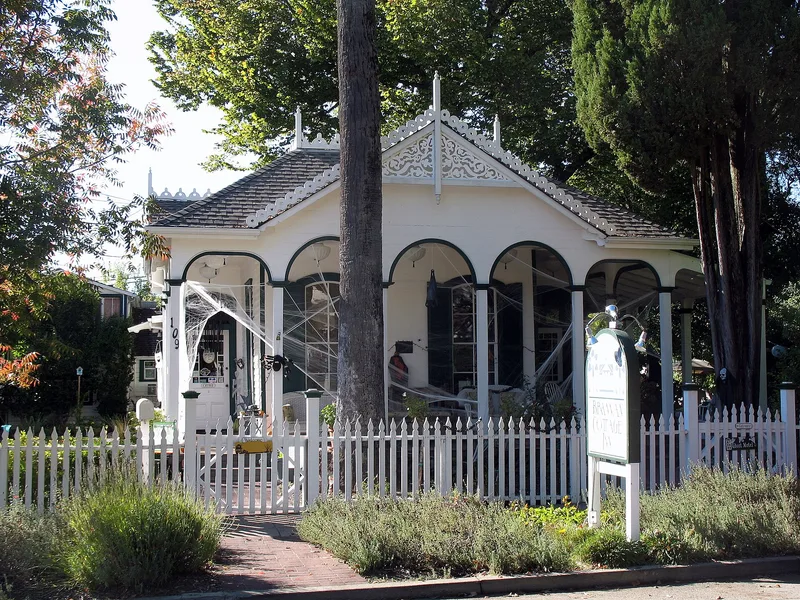
This wood-frame cottage at 109 Wapoo Avenue in Calistoga was built in 1862 as a guest cottage for Sam Brannan's Calistoga Hot Springs Resort. Of the 25 cottages that once surrounded the resort, it is the last remaining on its original site, and it still has the palm tree that Robert Louis Stevenson called a "weedy palm" in The Silverado Squatters. The original building had gabled roofs, a wraparound porch with arches, and decorative bargeboard. Alterations in 1905 removed the roof cresting and finials and added a porch extension and a rear addition containing two apartments. A garage and a walk-up flat were also built nearby. Brannan's resort helped drive Calistoga's growth and inspired other spas in the valley. After about 1875-1925 as a private residence, the cottage served as a rooming house with sulphur baths, then as an apartment house from about 1955.
Significance in brief: It is the last of the resort's 25 guest cottages remaining on its original site, still with its palm tree described by Robert Louis Stevenson in The Silverado Squatters. Brannan's development of the area's geothermal resource was important to Napa County's commercial growth and inspired other resorts. Its classical architecture conveyed leisure and civilization in early Calistoga.
Machine-generated summary. This summary was generated by a language model from the official nomination document and has not been reviewed line by line by an editor. It may contain errors. Check the source document before relying on any detail. Source: nomination document (PDF) · National Archives catalog entry. NRHP reference 83001211, listed August 18, 1983. Summary generated October 2026 (model claude-sonnet-5-5, prompt v1.0-2026-10-29, confidence high).
Key facts
| Address | 109 Wapoo Ave., Calistoga |
|---|---|
| County | Napa County |
| Listed | August 18, 1983 |
| Reference number | 83001211 |
| Resource type | Building |
| Period of significance | 1800-1899 |
| Architect / builder | Unknown |
| Areas of significance | Commerce, Architecture |
| Level of significance | Local |
| Status (as stated in the nomination) | Occupied as a private residence (apartments); condition listed as fair and altered, though the original features remain or can be reclaimed by rehabilitation. |
| Acreage | 0.3 |
| Coordinates | 38.58226, -122.57733 (NPS GIS) |
What listing means for this property
National Register listing is honorary for a privately owned home: it does not by itself restrict what an owner may do with their own money, and it does not require public access. Restrictions come from local landmark or historic-district ordinances, which are separate (how they differ).
Owner-occupied houses are not eligible for the 20% federal rehabilitation tax credit, which applies to income-producing buildings, but many states offer credits for homeowners. Listing also opens the door to preservation easements and to buying a plaque. Start with what listing means for homeowners, renovating a listed house and selling one.
General information, not legal or tax advice. Rules change; confirm with your State Historic Preservation Office or a qualified adviser.
Sources and further reading
- National Park Service, National Register of Historic Places database (snapshot May 2026), reference 83001211.
- Nomination form (PDF, National Archives) — catalog entry
- Wikipedia article (used for cross-checking only; text not reproduced here)
- Wikidata Q65067051
- This listing as JSON
Last updated October 2026. Found an error? See the editorial policy for how to report it.