Francis, James H., House
Also known as: Francis House; Calistoga Hospital

Why it's listed
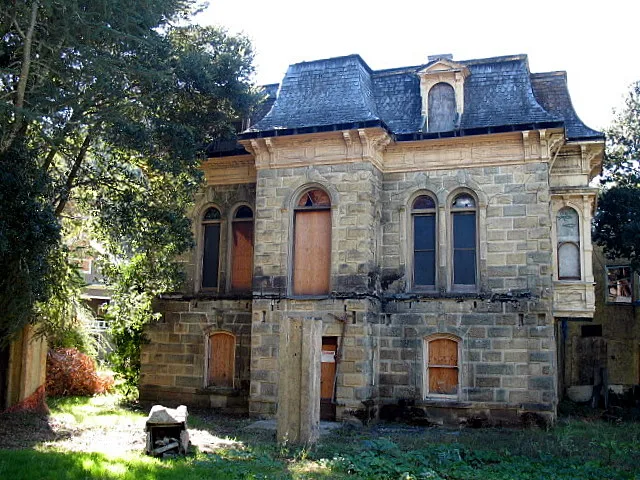
Built in 1886 on a corner lot at Spring and Myrtle Streets in Calistoga, this three-story house was made for James H. Francis, a local merchant and rancher. John Sexton built it from native stone quarried and cut south of town. Its square plan, projecting central pavilion, paired arched windows and bellcast mansard roof with pedimented dormers are typical of the Second Empire style. It is believed to be the only stone house of that style in Napa County, and its craftsmanship resembles stonework more often found in wineries. After Francis died in 1891 the house changed hands, and in 1918 it became the Calistoga Hospital, which operated until 1964. A large front portico and a masonry addition date from the hospital years, and the interior was altered, but the stone exterior has weathered well. At the time of the nomination the building stood vacant and deteriorating, still a prominent landmark in an early residential neighborhood.
Significance in brief: It is believed to be the only stone Second Empire residence in Napa County and shows a level of local stonemasonry usually seen in wineries rather than houses. It is one of two Second Empire residences in Calistoga and reflects the prosperous 1870s and 1880s. It also stands as a focal point of one of the town's earliest residential neighborhoods.
Machine-generated summary. This summary was generated by a language model from the official nomination document and has not been reviewed line by line by an editor. It may contain errors. Check the source document before relying on any detail. Source: nomination document (PDF) · National Archives catalog entry. NRHP reference 79000503, listed January 31, 1979. Summary generated October 2026 (model claude-sonnet-5-5, prompt v1.0-2026-10-29, confidence high).
Key facts
| Address | 1403 Myrtle St., Calistoga |
|---|---|
| County | Napa County |
| Listed | January 31, 1979 |
| Reference number | 79000503 |
| Resource type | Building |
| Period of significance | 1886 |
| Architect / builder | Stonemason/builder: John Sexton (architect unknown; stone quarried and cut by John McPherson) |
| Architectural style | Second Empire |
| Areas of significance | Architecture |
| Level of significance | Local |
| Status (as stated in the nomination) | Listed as vacant and unoccupied, in rapidly deteriorating condition; served as the Calistoga Hospital from 1918 until 1964. |
| Acreage | 0.4 |
| Coordinates | 38.57661, -122.58253 (NPS GIS) |
What listing means for this property
National Register listing is honorary for a privately owned home: it does not by itself restrict what an owner may do with their own money, and it does not require public access. Restrictions come from local landmark or historic-district ordinances, which are separate (how they differ).
Owner-occupied houses are not eligible for the 20% federal rehabilitation tax credit, which applies to income-producing buildings, but many states offer credits for homeowners. Listing also opens the door to preservation easements and to buying a plaque. Start with what listing means for homeowners, renovating a listed house and selling one.
Noted as vacant in the nomination. Nomination documents can be decades old; current status may differ. If you are considering buying an empty listed property, read the due-diligence checklist.
General information, not legal or tax advice. Rules change; confirm with your State Historic Preservation Office or a qualified adviser.
Sources and further reading
- National Park Service, National Register of Historic Places database (snapshot May 2026), reference 79000503.
- Nomination form (PDF, National Archives) — catalog entry
- Wikipedia article (used for cross-checking only; text not reproduced here)
- Wikidata Q96384129
- This listing as JSON
Last updated October 2026. Found an error? See the editorial policy for how to report it.