Pacific Biological Laboratories
Also known as: Doc's Lab

Why it's listed
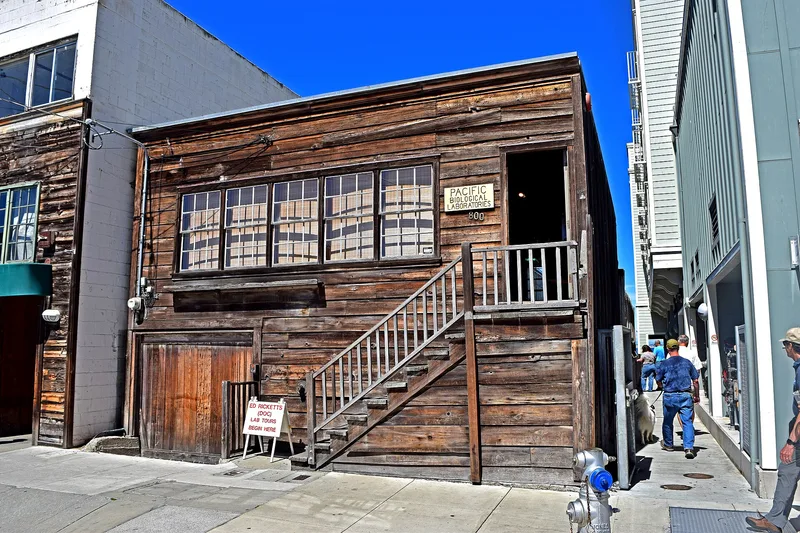
Doc's Lab is a modest two-story wood-frame building near the northwest end of Cannery Row in Monterey. Built in 1937 after fire destroyed the previous laboratory, it housed the Pacific Biological Laboratories, a company supplying marine specimens to scientists. Its owner, Edward F. "Doc" Ricketts, made it a gathering place for artists, writers and thinkers, and his pioneering work on Pacific Coast intertidal life became a standard reference. His close friend John Steinbeck collaborated with him, became a stockholder in the company, and drew on the lab and its circle for Cannery Row and other works. The building has a concrete foundation, board-and-batten walls, a shiplap front and a flat roof, with specimen tanks and a reduction vat behind. Friends bought it in the mid-1950s and kept it as a social club with little change. It was listed for its ties to Ricketts and Steinbeck and its standing as a literary landmark.
Significance in brief: The lab was the business and gathering place of marine biologist Edward F. "Doc" Ricketts, whose pioneering studies of Pacific Coast intertidal life remain basic texts. It was also the close companion and creative base of novelist John Steinbeck, and the focal point of Steinbeck's novel Cannery Row. The nomination argues it is a rare surviving literary icon and merits national-level significance.
Machine-generated summary. This summary was generated by a language model from the official nomination document and has not been reviewed line by line by an editor. It may contain errors. Check the source document before relying on any detail. Source: nomination document (PDF) · National Archives catalog entry. NRHP reference 94001498, listed December 29, 1994. Summary generated October 2026 (model claude-sonnet-5-5, prompt v1.0-2026-10-29, confidence high).
Key facts
| Address | 800 Cannery Row, Monterey |
|---|---|
| County | Monterey County |
| Listed | December 29, 1994 |
| Reference number | 94001498 |
| Resource type | Building |
| Period of significance | 1937-1945 |
| Architect / builder | Onweiler (contractor) |
| Architectural style | no style |
| Criteria |
|
| Areas of significance | Literature, Science |
| Level of significance | National |
| Status (as stated in the nomination) | Used as a social club (men's social club since the mid-1950s); the exterior retains its historic appearance, with changes mainly at the rear porch and stairs, and the second-floor interior modified. |
| Acreage | 0.9 |
| Coordinates | 36.61689, -121.90080 (NPS GIS) |
What listing means for this property
National Register listing is honorary: it recognises significance and does not restrict what a private owner may do without federal money or permits. It unlocks the 20% federal rehabilitation tax credit for income-producing buildings, state credits in many states, and Section 106 review when federal agencies are involved. See what listing means in practice.
General information, not legal or tax advice. Rules change; confirm with your State Historic Preservation Office or a qualified adviser.
Sources and further reading
- National Park Service, National Register of Historic Places database (snapshot May 2026), reference 94001498.
- Nomination form (PDF, National Archives) — catalog entry
- Wikipedia article (used for cross-checking only; text not reproduced here)
- Wikidata Q7122315
- This listing as JSON
Last updated October 2026. Found an error? See the editorial policy for how to report it.