Town House, The
Also known as: Sheraton Town House; Sheraton West

Why it's listed
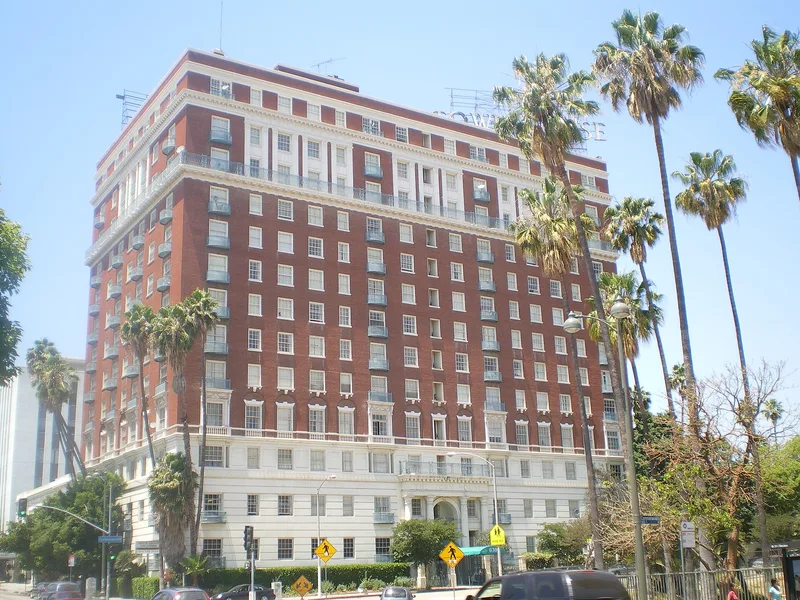
Rising thirteen stories at the corner of Wilshire Boulevard and Commonwealth Avenue in Los Angeles, this apartment hotel was built between 1928 and 1929 to designs by architect Norman W. Alpaugh. The complex includes an L-shaped steel-frame tower clad in cast stone, brick and terra cotta, a two-story dining annex, and subterranean garages. Its Period Revival design blends Classical and Georgian elements with delicate Adamesque ironwork, a Greek fretwork stringcourse and a columned entrance portico. The exterior remains largely intact, though the interior has been heavily remodeled. Because Wilshire changes direction at this corner, westbound drivers see the tower directly ahead, which made it the most prominent landmark at the eastern end of the boulevard. It was listed as an example of Period Revival design and as the most notable work of Alpaugh, whose obituary singled it out. Later additions such as a pool and lanai buildings do not contribute. The property has been vacant since the hotel closed in 1993.
Significance in brief: The nomination argues it is an outstanding example of Period Revival architectural design, combining Classical, Georgian and Adamesque details. It is also the finest documented work of architect Norman W. Alpaugh. Its height and siting at a bend in Wilshire Boulevard made it a prominent landmark of the boulevard.
Machine-generated summary. This summary was generated by a language model from the official nomination document and has not been reviewed line by line by an editor. It may contain errors. Check the source document before relying on any detail. Source: nomination document (PDF) · National Archives catalog entry. NRHP reference 96000821, listed December 15, 1997. Summary generated October 2026 (model claude-sonnet-5-5, prompt v1.0-2026-10-29, confidence high).
Key facts
| Address | 2959--2973 Wilshire Blvd. and 607--643 S. Commonwealth Ave., Los Angeles |
|---|---|
| County | Los Angeles County |
| Listed | December 15, 1997 |
| Reference number | 96000821 |
| Resource type | Building |
| Period of significance | 1929 |
| Architect / builder | Alpaugh, Norman W. |
| Architectural style | Late Nineteenth and Twentieth Century Revivals: Period Revival |
| Criteria |
|
| Areas of significance | Architecture |
| Level of significance | Local |
| Status (as stated in the nomination) | The entire property is vacant and secured; it ceased functioning as a hotel in February 1993. |
| Acreage | 2.5 |
| Coordinates | 34.06219, -118.28562 (NPS GIS) |
What listing means for this property
National Register listing is honorary for a privately owned home: it does not by itself restrict what an owner may do with their own money, and it does not require public access. Restrictions come from local landmark or historic-district ordinances, which are separate (how they differ).
Owner-occupied houses are not eligible for the 20% federal rehabilitation tax credit, which applies to income-producing buildings, but many states offer credits for homeowners. Listing also opens the door to preservation easements and to buying a plaque. Start with what listing means for homeowners, renovating a listed house and selling one.
Noted as vacant in the nomination. Nomination documents can be decades old; current status may differ. If you are considering buying an empty listed property, read the due-diligence checklist.
General information, not legal or tax advice. Rules change; confirm with your State Historic Preservation Office or a qualified adviser.
Sources and further reading
- National Park Service, National Register of Historic Places database (snapshot May 2026), reference 96000821.
- Nomination form (PDF, National Archives) — catalog entry
- Wikipedia article (used for cross-checking only; text not reproduced here)
- Wikidata Q7769777
- This listing as JSON
Last updated October 2026. Found an error? See the editorial policy for how to report it.