Los Angeles Plaza Historic District
Also known as: El Pueblo de Los Angeles State Historic Park

Why it's listed
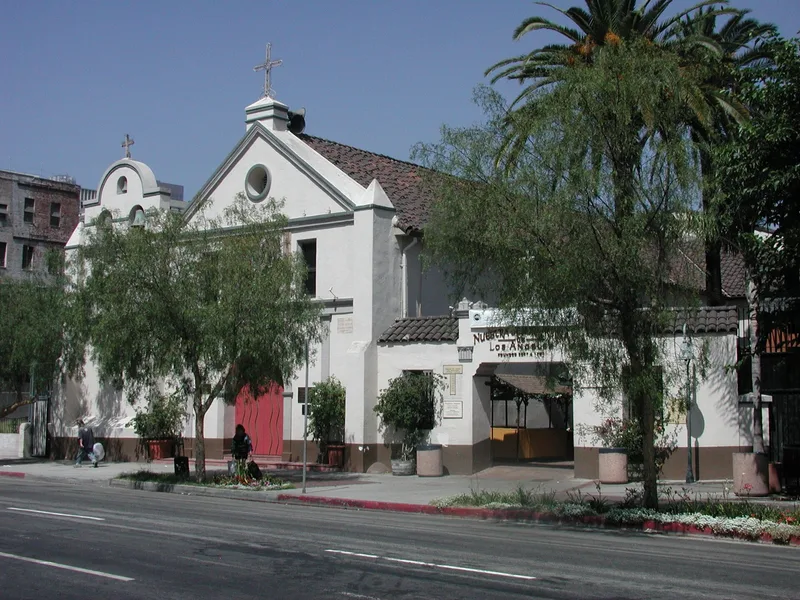
Downtown Los Angeles grew from a small pueblo founded in 1781, and its original core survives as a 42-acre historic district around the Plaza. The area holds buildings from several eras: the Avila Adobe of 1818, the Plaza Church of 1822, the Pelanconi House from the 1850s, the Masonic Hall of 1858, and the Pico House and Merced Theatre of about 1870. Later Victorian additions include the Sepulveda Building and the Garnier Building, built in 1890 for Chinese tenants. Olvera Street, a brick-paved market lane, adds a Mexican character. The district declined into a semi-slum around 1900 before cleanup efforts led by Christine Sterling revived Olvera Street. The State, City and County acquired the area in 1953 as a state historic park, and restoration continued into the 1970s. The nomination presents the district as the living record of the city's growth through Spanish, Mexican and American periods, and as the only pueblo of its kind to survive in California.
Significance in brief: The nomination argues the district is where Los Angeles was founded and a hub of its growth through the Spanish, Mexican and American periods. It is the only surviving one of two Spanish pueblos founded in California. Its buildings show the blending of ethnic groups and architectural styles that shaped the city.
Machine-generated summary. This summary was generated by a language model from the official nomination document and has not been reviewed line by line by an editor. It may contain errors. Check the source document before relying on any detail. Source: nomination document (PDF) · National Archives catalog entry. NRHP reference 72000231, listed November 3, 1972. Summary generated October 2026 (model claude-sonnet-5-5, prompt v1.0-2026-10-29, confidence medium).
Key facts
| Address | Roughly bounded by Spring, Macy, Alameda and Arcadia Sts., and Old Sunset Blvd., Los Angeles |
|---|---|
| County | Los Angeles County |
| Listed | November 3, 1972 |
| Reference number | 72000231 |
| Resource type | District |
| Architect / builder | Masonic Building built 1858 by the firm of Terry and Woodworth; Merced Theatre started by William Abbott; Garnier Building built by Phillippe Garnier; Sepulveda Building built by Eloisa Martinez de Sepulveda |
| Architectural style | Mission Adobe period, Victorian brick and stone, and later concrete and plaster structures |
| Areas of significance | Commerce, Politics/Government, Hispanic, Architecture, Social History |
| Level of significance | State |
| Status (as stated in the nomination) | Condition marked fair and altered; several buildings restored, with the Avila Adobe being restored after the 1971 earthquake. The area is used as a state historic park with museums, shops, restaurants and offices. |
| Acreage | 42 |
| Coordinates | 34.05662, -118.23964 (NPS GIS) |
What listing means for this property
This is a historic district. Buildings within its boundary are either contributing (they add to the district's significance) or non-contributing. Owners of contributing income-producing buildings can claim the 20% federal rehabilitation tax credit; homeowners should look at state credits. National Register districts impose no design review by themselves; a local historic district ordinance, if one exists, does (the difference explained).
General information, not legal or tax advice. Rules change; confirm with your State Historic Preservation Office or a qualified adviser.
Sources and further reading
- National Park Service, National Register of Historic Places database (snapshot May 2026), reference 72000231.
- Nomination form (PDF, National Archives) — catalog entry
- Wikipedia article (used for cross-checking only; text not reproduced here)
- Wikidata Q6682294
- This listing as JSON
Last updated October 2026. Found an error? See the editorial policy for how to report it.