Choy, Sam, Brick Store
Also known as: Angels Camp Jail

Why it's listed
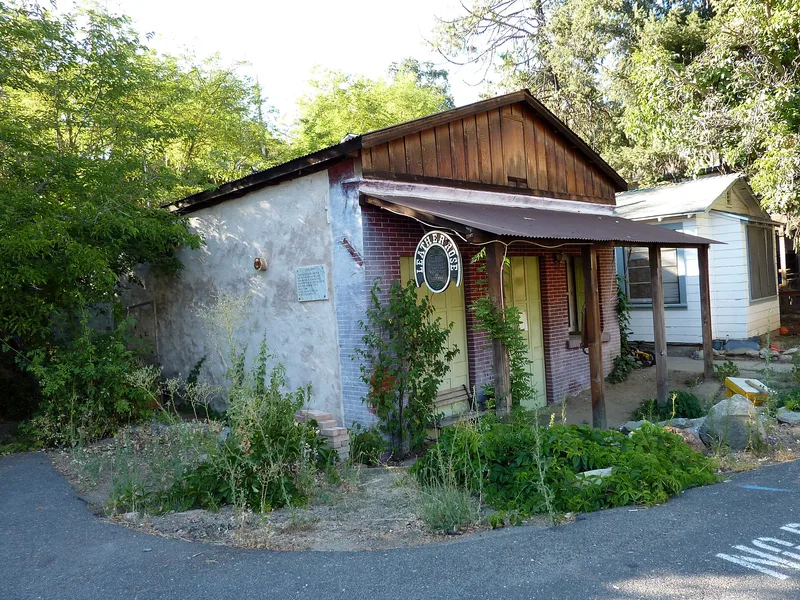
Built in 1860-61 on what is now Bird Way in Angels Camp, this small commercial building has a three-bay brick front, brick relieving arches over two doors and a window, and solid native schist side and rear walls. It was built for Sam Choy, a successful Chinese merchant who occupied it until 1892 and who also owned gambling houses and supplied contract labor to mine owners. Chinatown once held about 20 properties, and this store is described as one of only two surviving from that era. After 1892 the building gained a frame second story and was used as a boarding house, and in the 1930s the upper story was removed when it became the city jail, a use that lasted until the mid-1950s. Iron shutters, some with holes cut for the jail, remain. The building is now empty, and the City of Angels Camp hopes to restore it as a museum. A plaque was placed on its west wall in 1980.
Significance in brief: The nomination calls it one of only two remaining buildings from the period of Chinese occupancy in Angels Camp, tied to the prosperous merchant Sam Choy. It is also presented as an outstanding example of 1855-65 Mother Lode commercial architecture, with a three-bay brick front and stone side and rear walls. Its later uses as a boarding house and the city jail add to its unusual local history.
Machine-generated summary. This summary was generated by a language model from the official nomination document and has not been reviewed line by line by an editor. It may contain errors. Check the source document before relying on any detail. Source: nomination document (PDF) · National Archives catalog entry. NRHP reference 84000759, listed September 20, 1984. Summary generated October 2026 (model claude-sonnet-5-5, prompt v1.0-2026-10-29, confidence high).
Key facts
| Address | Bird Way, Angels Camp |
|---|---|
| County | Calaveras County |
| Listed | September 20, 1984 |
| Reference number | 84000759 |
| Resource type | Building |
| Period of significance | 1800-1899, 1900- (specific dates 1860, 1930's) |
| Architect / builder | Unknown |
| Architectural style | Mother Lode brick Classical Revival (stripped Classical Revival commercial building) |
| Areas of significance | Asian, Architecture |
| Level of significance | Local |
| Status (as stated in the nomination) | Vacant and in the city's hands; the nomination states it has stood empty for many years, and the city plans to restore it as a museum. |
| Acreage | 0.1 |
| Coordinates | 38.06914, -120.53944 (NPS GIS) |
What listing means for this property
For an income-producing building, listing (individually or as a contributing building in a district) is the gateway to the 20% federal rehabilitation tax credit on qualified rehabilitation costs, often stackable with state credits. Work claiming the credit must follow the Secretary of the Interior's Standards and be approved in advance.
Listing does not restrict a private owner acting without federal money or permits; where federal funding or licensing is involved, Section 106 review applies.
Noted as vacant in the nomination. Nomination documents can be decades old; current status may differ. If you are considering buying an empty listed property, read the due-diligence checklist.
General information, not legal or tax advice. Rules change; confirm with your State Historic Preservation Office or a qualified adviser.
Sources and further reading
- National Park Service, National Register of Historic Places database (snapshot May 2026), reference 84000759.
- Nomination form (PDF, National Archives) — catalog entry
- Wikipedia article (used for cross-checking only; text not reproduced here)
- Wikidata Q7407318
- This listing as JSON
Last updated October 2026. Found an error? See the editorial policy for how to report it.