Berkeley Historic Civic Center District

Why it's listed
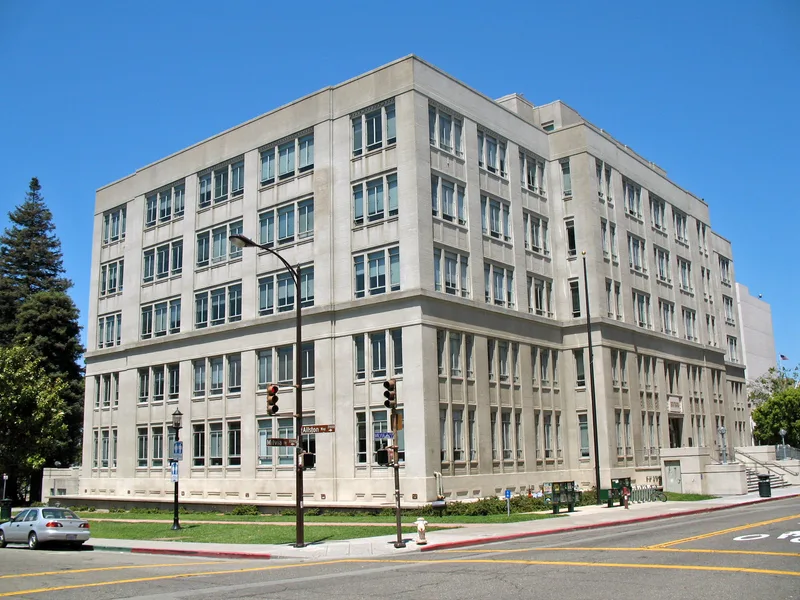
Berkeley's Civic Center district covers parts of a five-block area around Martin Luther King Jr. Civic Center Park, bounded by McKinley Street, Milvia Street, Allston Way and Center Street. It contains nine contributing buildings, a park and a fountain, built between 1909 and 1950. The earliest are "Old" City Hall (1909), designed by John Bakewell and Arthur Brown Jr. in Beaux Arts style, and the 1914 Post Office in Classic Italian Renaissance style. Later buildings, including the 1928 Veterans Memorial Building, the former Federal Land Bank building and the Berkeley Community Theater, are largely Moderne. Four main buildings sit on a cross axis centered on the Moderne concrete fountain in the park, which was completed in 1942. The district matters because decades of City Beautiful planning, local progressive government and New Deal funding produced a cohesive ensemble. Its buildings share a compatible palette of pale colors and have kept a high degree of integrity.
Significance in brief: The district is significant as a cohesive civic center that took more than three decades of planning and land acquisition to complete. Its buildings, park and fountain reflect City Beautiful planning ideas, Berkeley's progressive local government and policing, and New Deal era federal programs such as the Federal Land Bank. Its Beaux Arts, Classic Italian Renaissance and Moderne architecture retains a high degree of integrity.
Machine-generated summary. This summary was generated by a language model from the official nomination document and has not been reviewed line by line by an editor. It may contain errors. Check the source document before relying on any detail. Source: nomination document (PDF) · National Archives catalog entry. NRHP reference 98000963, listed December 3, 1998. Summary generated October 2026 (model claude-sonnet-5-5, prompt v1.0-2026-10-29, confidence medium).
Key facts
| Address | Roughly bounded by McKinney Ave., Addison St., Shattuck Ave., and Kittredge St., Berkeley |
|---|---|
| County | Alameda County |
| Listed | December 3, 1998 |
| Reference number | 98000963 |
| Resource type | District |
| Period of significance | 1909-1950 |
| Architect / builder | John Bakewell & Arthur Brown Jr. (City Hall); Henry H. Meyers (Veterans Memorial Building); Henry Gutterson, Bernard Maybeck, Julia Morgan and John Gregg (park design committee) |
| Architectural style | Early 20th Century: Beaux Arts Classicism, Moderne, Art Deco |
| Areas of significance | Community Planning and Development, Architecture, Social History, Politics/Government |
| Level of significance | Local |
| Status (as stated in the nomination) | General condition of the buildings is described as good to excellent, with no significant alterations to the park or contributing buildings; the Veterans Memorial Building is still in use. |
| Acreage | 9.9 |
| Coordinates | 37.86946, -122.27139 (NPS GIS) |
What listing means for this property
This is a historic district. Buildings within its boundary are either contributing (they add to the district's significance) or non-contributing. Owners of contributing income-producing buildings can claim the 20% federal rehabilitation tax credit; homeowners should look at state credits. National Register districts impose no design review by themselves; a local historic district ordinance, if one exists, does (the difference explained).
General information, not legal or tax advice. Rules change; confirm with your State Historic Preservation Office or a qualified adviser.
Sources and further reading
- National Park Service, National Register of Historic Places database (snapshot May 2026), reference 98000963.
- Nomination form (PDF, National Archives) — catalog entry
- Wikipedia article (used for cross-checking only; text not reproduced here)
- Wikidata Q120142874
- This listing as JSON
Last updated October 2026. Found an error? See the editorial policy for how to report it.