Graham's Forge Mill
Also known as: 098-0052

Why it's listed
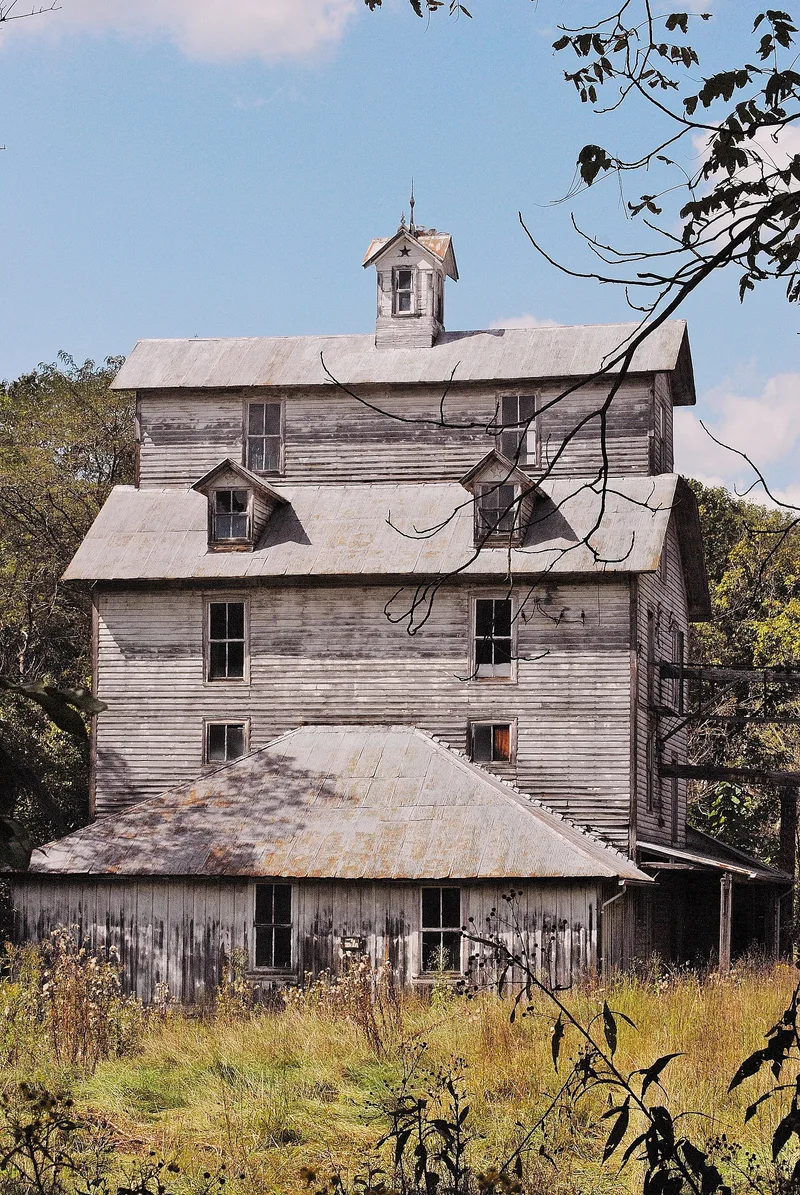
Graham's Forge Mill is a five-story frame flour mill built around 1890 beside Reed Creek in eastern Wythe County, Virginia. It rises from a limestone foundation, with weatherboard walls, a standing-seam metal roof, dormers, and a cupola with a star motif and decorative cresting. Inside, grain bins, chutes and milling machinery remain in place. Nearby are a grain storage building, smokehouse, corncrib, oven and kettle remains, and a mill dam. The site has long industrial roots: the Crockett brothers ran ironworks here by 1796, and David Graham later made the forge the centre of a large iron business that his family continued for decades. When the iron market declined, Major David P. Graham and John W. Robinson built the flour mill in 1889-90. It ground wheat flour and cornmeal for farmers in eastern Wythe County until 1934. The property is valued for its role in the local economy and for its largely intact architecture and outbuildings.
Significance in brief: The nomination argues the mill was important to Wythe County's economy in the late nineteenth and early twentieth centuries and is an excellent example of a relatively large-scale milling operation in rural southwestern Virginia. It also claims architectural significance for the mill's high artistic values, period construction techniques and its surviving group of associated structures. The mill occupies the site of earlier ironworks, the Crockett Forge and Graham's Forge.
Machine-generated summary. This summary was generated by a language model from the official nomination document and has not been reviewed line by line by an editor. It may contain errors. Check the source document before relying on any detail. Source: nomination document (PDF) · National Archives catalog entry. NRHP reference 05000481, listed May 26, 2005. Summary generated October 2026 (model claude-sonnet-5-5, prompt v1.0-2026-10-29, confidence high).
Key facts
| Address | VA 639, Max Meadows |
|---|---|
| County | Wythe County |
| Listed | May 26, 2005 |
| Reference number | 05000481 |
| Resource type | Building |
| Period of significance | ca. 1890-1934 |
| Architectural style | Late Victorian |
| Criteria |
|
| Areas of significance | Architecture, Industry, Engineering |
| Level of significance | Local |
| Status (as stated in the nomination) | Current function is listed as vacant/not in use. The workshop is in terminal condition and expected to be taken down; the mill wheel is missing. |
| Acreage | 3.9 |
| Coordinates | 36.94225, -80.88591 (NPS GIS) |
What listing means for this property
For an income-producing building, listing (individually or as a contributing building in a district) is the gateway to the 20% federal rehabilitation tax credit on qualified rehabilitation costs, often stackable with state credits. Work claiming the credit must follow the Secretary of the Interior's Standards and be approved in advance.
Listing does not restrict a private owner acting without federal money or permits; where federal funding or licensing is involved, Section 106 review applies.
Noted as vacant in the nomination. Nomination documents can be decades old; current status may differ. If you are considering buying an empty listed property, read the due-diligence checklist.
General information, not legal or tax advice. Rules change; confirm with your State Historic Preservation Office or a qualified adviser.
Sources and further reading
- National Park Service, National Register of Historic Places database (snapshot May 2026), reference 05000481.
- Nomination form (PDF, National Archives) — catalog entry
- Wikipedia article (used for cross-checking only; text not reproduced here)
- Wikidata Q15222001
- This listing as JSON
Last updated October 2026. Found an error? See the editorial policy for how to report it.