Campbell Farm
Also known as: Hite Farm; DHR File 85-127
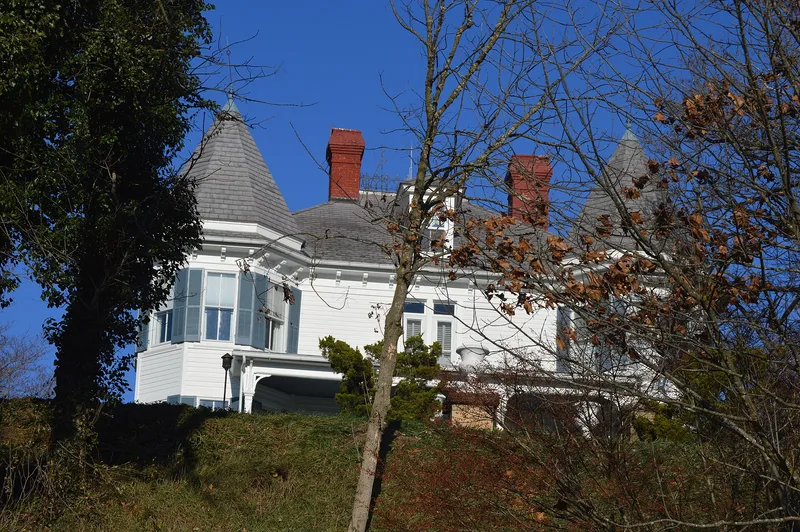

Why it's listed
Overlooking the village of Lantz Mills from a hilltop in Shenandoah County, this farm centers on a two-and-one-half story Queen Anne house completed in 1888-1889 for Milton M. Campbell. The weatherboard house has a patterned slate hipped roof, conical corner towers, sawnwork gables, iron cresting and a wooden porch, and its interior retains bull's-eye corner blocks, ceiling medallions and period mantels. Seven frame outbuildings stand to the west, including a wash house, privy, hog barn, barn, machine shed and corn crib. Campbell worked for the Columbia-Liberty Iron Company, owned by his wife's family, which bought two local furnaces after the Civil War. When the ironworks failed in 1907, a lender foreclosed on the farm in 1908. The property is recognized for its connection to Virginia's postbellum iron industry and as a locally important, largely intact example of Queen Anne architecture.
Significance in brief: The nomination argues the farm is significant under Criterion A for its link to the short-lived postbellum Virginia iron industry, since Campbell worked for his in-laws' Columbia-Liberty Iron Company. Under Criterion C it is a locally important example of a Queen Anne dwelling built during Shenandoah County's postbellum economic boom. Its ownership history also reflects the economic uncertainty of the Gilded Age.
Machine-generated summary. This summary was generated by a language model from the official nomination document and has not been reviewed line by line by an editor. It may contain errors. Check the source document before relying on any detail. Source: nomination document (PDF) · National Archives catalog entry. NRHP reference 90001416, listed August 15, 1990. Summary generated October 2026 (model claude-sonnet-5-5, prompt v1.0-2026-10-29, confidence high).
Key facts
| Address | VA 675, near Lantz Mills, Edinburg |
|---|---|
| County | Shenandoah County |
| Listed | August 15, 1990 |
| Reference number | 90001416 |
| Resource type | Building |
| Period of significance | 1888-1908 |
| Architectural style | Late Victorian: Queen Anne |
| Criteria |
|
| Areas of significance | Industry, Architecture |
| Level of significance | Local |
| Status (as stated in the nomination) | Remains a single dwelling with its agricultural outbuildings in use; described as remarkably intact, with all outbuildings in good condition. |
| Acreage | 89 |
| Coordinates | 38.84363, -78.59109 (NPS GIS) |
What listing means for this property
National Register listing is honorary for a privately owned home: it does not by itself restrict what an owner may do with their own money, and it does not require public access. Restrictions come from local landmark or historic-district ordinances, which are separate (how they differ).
Owner-occupied houses are not eligible for the 20% federal rehabilitation tax credit, which applies to income-producing buildings, but many states offer credits for homeowners. Listing also opens the door to preservation easements and to buying a plaque. Start with what listing means for homeowners, renovating a listed house and selling one.
General information, not legal or tax advice. Rules change; confirm with your State Historic Preservation Office or a qualified adviser.
Sources and further reading
- National Park Service, National Register of Historic Places database (snapshot May 2026), reference 90001416.
- Nomination form (PDF, National Archives) — catalog entry
- Wikipedia article (used for cross-checking only; text not reproduced here)
- Wikidata Q5028059
- This listing as JSON
Last updated October 2026. Found an error? See the editorial policy for how to report it.