Jessees Mill
Also known as: 083-5152-0001

Why it's listed
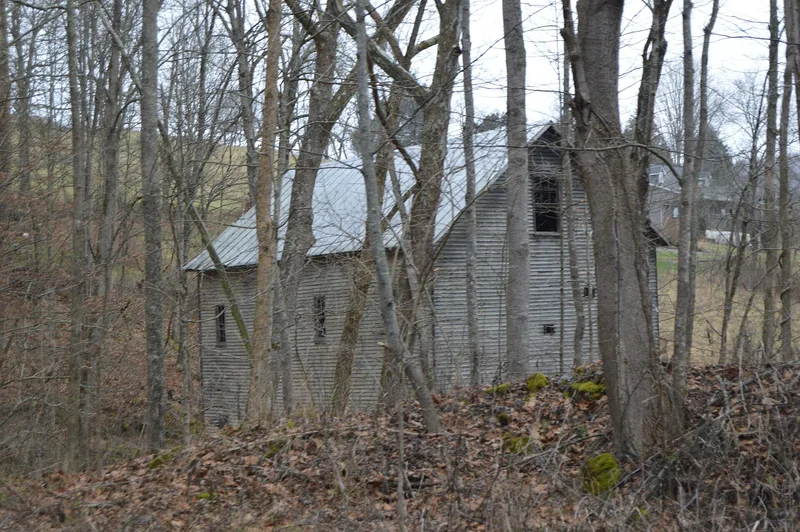
Jessees Mill sits beside a waterfall on Mill Creek in the Clinch River Valley of Russell County, Virginia. It began around 1850 as a one-room log building where grain was ground between millstones by water power. Around 1890, Andrew Jackson Jessee enlarged it with a two-story balloon frame addition built on top of the log structure, which now forms the basement. The addition housed roller milling equipment, stenciled as made by Salem Machine Works, and nearly all of it remains in place. The original millstones, wooden gears and a steel overshot water wheel also survive. A stone dam, believed to date from the early period, and a timber frame barn complete the nominated parcel. The mill served local families as a source of processed grain until it closed in 1932. It is valued for its role in community life, its surviving engineering, and its construction, and few mills like it remain in the region.
Significance in brief: The mill is argued to be locally significant under Criterion A in Industry for its role in processing grain for the local community through the 19th and early 20th centuries. It is also significant in Engineering because equipment from two milling eras survives in place, and under Criterion C in Architecture for the quality of its design and craftsmanship. Few comparable mills survive in the region.
Machine-generated summary. This summary was generated by a language model from the official nomination document and has not been reviewed line by line by an editor. It may contain errors. Check the source document before relying on any detail. Source: nomination document (PDF) · National Archives catalog entry. NRHP reference 04001543, listed January 20, 2005. Summary generated October 2026 (model claude-sonnet-5-5, prompt v1.0-2026-10-29, confidence high).
Key facts
| Address | VA 645, 2.5 mi. N of VA 71, Cleveland |
|---|---|
| County | Russell County |
| Listed | January 20, 2005 |
| Reference number | 04001543 |
| Resource type | Building |
| Period of significance | ca. 1850-1932 |
| Architect / builder | unknown |
| Architectural style | no style |
| Criteria |
|
| Areas of significance | Architecture, Industry, Engineering |
| Level of significance | Local |
| Status (as stated in the nomination) | Current function is listed as vacant/not in use; the mill ceased operating in 1932. The millpond does not survive, the water wheel is rusted and mired in alluvium, and several windows are missing. |
| Acreage | 1 |
| Coordinates | 36.91567, -82.17078 (NPS GIS) |
What listing means for this property
For an income-producing building, listing (individually or as a contributing building in a district) is the gateway to the 20% federal rehabilitation tax credit on qualified rehabilitation costs, often stackable with state credits. Work claiming the credit must follow the Secretary of the Interior's Standards and be approved in advance.
Listing does not restrict a private owner acting without federal money or permits; where federal funding or licensing is involved, Section 106 review applies.
Noted as vacant in the nomination. Nomination documents can be decades old; current status may differ. If you are considering buying an empty listed property, read the due-diligence checklist.
General information, not legal or tax advice. Rules change; confirm with your State Historic Preservation Office or a qualified adviser.
Sources and further reading
- National Park Service, National Register of Historic Places database (snapshot May 2026), reference 04001543.
- Nomination form (PDF, National Archives) — catalog entry
- Wikipedia article (used for cross-checking only; text not reproduced here)
- Wikidata Q15229526
- This listing as JSON
Last updated October 2026. Found an error? See the editorial policy for how to report it.