Tunker House
Also known as: Yount-Zigler House

Why it's listed
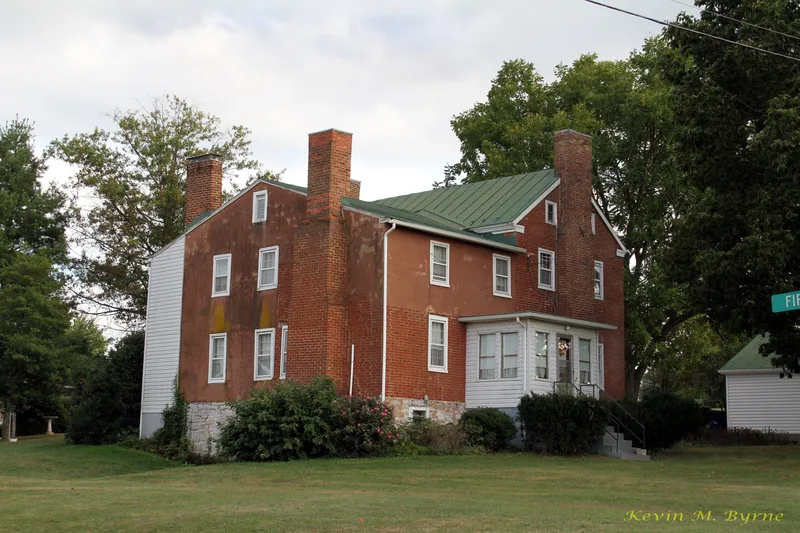
Near Broadway in Rockingham County, Virginia, the Tunker House grew from a one-story Flemish bond brick dwelling built around 1798 by Benjamin Yount. Between 1802 and 1806 Yount added a two-story brick block at right angles to it, and the older section was later raised to two stories and widened with a frame addition. The most notable feature is a pair of large pine partitions on the first floor that could be swung up to the ceiling, turning two front rooms into a single meeting hall. From the early 1800s until 1830, German Baptists, known as Tunkers or Brethren, worshipped here, which gave the house its name. Peter Nead, who married Yount's daughter and inherited the house in 1834, lived here and wrote Primitive Christianity in 1833, the first printed English-language theology for the Brethren. The house is described as the only surviving Brethren meeting place in the Shenandoah Valley.
Significance in brief: The house served as a meeting place for the German Baptists (Tunkers or Brethren) from the early nineteenth century until 1830, using partitions that could be raised to form one large room. Peter Nead, an important early Church of the Brethren leader, lived here and wrote Primitive Christianity in 1833. It is described as the only surviving Brethren meeting place in the Shenandoah Valley.
Machine-generated summary. This summary was generated by a language model from the official nomination document and has not been reviewed line by line by an editor. It may contain errors. Check the source document before relying on any detail. Source: nomination document (PDF) · National Archives catalog entry. NRHP reference 71000989, listed July 2, 1971. Summary generated October 2026 (model claude-sonnet-5-5, prompt v1.0-2026-10-29, confidence high).
Key facts
| Address | S of Broadway at jct. of VA 786 and 42, Broadway |
|---|---|
| County | Rockingham County |
| Listed | July 2, 1971 |
| Reference number | 71000989 |
| Resource type | Building |
| Period of significance | 19th Century (specific dates circa 1798, 1802-06) |
| Architect / builder | Benjamin Yount (builder) |
| Areas of significance | Religion |
| Level of significance | State |
| Status (as stated in the nomination) | Condition listed as excellent and altered; unoccupied at the time of nomination and being renovated by its owner. |
| Acreage | 9.9 |
| Coordinates | 38.60426, -78.79830 (NPS GIS) |
What listing means for this property
National Register listing is honorary for a privately owned home: it does not by itself restrict what an owner may do with their own money, and it does not require public access. Restrictions come from local landmark or historic-district ordinances, which are separate (how they differ).
Owner-occupied houses are not eligible for the 20% federal rehabilitation tax credit, which applies to income-producing buildings, but many states offer credits for homeowners. Listing also opens the door to preservation easements and to buying a plaque. Start with what listing means for homeowners, renovating a listed house and selling one.
Noted as vacant in the nomination. Nomination documents can be decades old; current status may differ. If you are considering buying an empty listed property, read the due-diligence checklist.
General information, not legal or tax advice. Rules change; confirm with your State Historic Preservation Office or a qualified adviser.
Sources and further reading
- National Park Service, National Register of Historic Places database (snapshot May 2026), reference 71000989.
- Nomination form (PDF, National Archives) — catalog entry
- Wikipedia article (used for cross-checking only; text not reproduced here)
- Wikidata Q16902071
- This listing as JSON
Last updated October 2026. Found an error? See the editorial policy for how to report it.