Funk, Joseph, House

Why it's listed
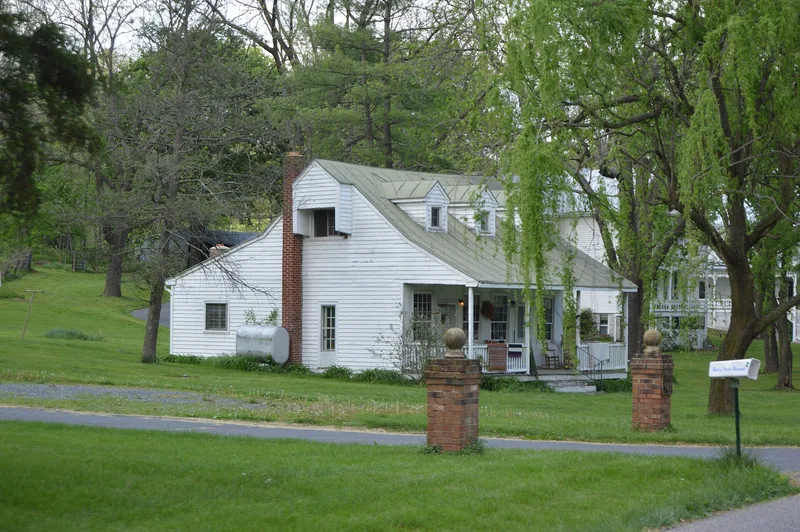
Built around 1810, this plain one-and-a-half-story log house with weatherboard sheathing, a gable roof and an undercut front gallery stands near Singers Glen in Rockingham County, Virginia. The north end chimney is original, while the opposite chimney, the three dormers and the rear section were added later. Inside, the front rooms keep horizontal board walls, exposed ceiling joists and a simple mantel. Joseph Funk (1777-1862) bought the land in 1809, and the house marks the beginning of the village. Funk was a Mennonite leader who translated Mennonite doctrine into English, taught sacred music and ran singing schools. He helped develop the patent note system of musical notation. His hymnal, the Harmonia Sacra, went through twenty-two editions. A second-floor room, once a loom room and later a school room, served as his publishing house from 1847 until 1878, when his grandsons moved the business to Dayton. The log spring house that held his press has been demolished.
Significance in brief: It was the home of Joseph Funk (1777-1862), a Mennonite leader, early English translator of Mennonite doctrine, and influential figure in sacred music and the patent note system of notation. The house marks the beginning of the village of Singers Glen. Funk's press, set up nearby in 1847, published religious and music books including the Harmonia Sacra.
Machine-generated summary. This summary was generated by a language model from the official nomination document and has not been reviewed line by line by an editor. It may contain errors. Check the source document before relying on any detail. Source: nomination document (PDF) · National Archives catalog entry. NRHP reference 75002036, listed February 24, 1975. Summary generated October 2026 (model claude-sonnet-5-5, prompt v1.0-2026-10-29, confidence high).
Key facts
| Address | VA 613, Singers Glen |
|---|---|
| County | Rockingham County |
| Listed | February 24, 1975 |
| Reference number | 75002036 |
| Resource type | Building |
| Period of significance | 19th Century (specific date c. 1810) |
| Architectural style | Vernacular |
| Areas of significance | Religion, Performing Arts |
| Level of significance | State |
| Status (as stated in the nomination) | Listed as in good condition, altered, on its original site, and occupied as a private residence. |
| Acreage | 0.9 |
| Within district | Singers Glen Historic District |
| Coordinates | 38.55093, -78.91754 (NPS GIS) |
What listing means for this property
National Register listing is honorary for a privately owned home: it does not by itself restrict what an owner may do with their own money, and it does not require public access. Restrictions come from local landmark or historic-district ordinances, which are separate (how they differ).
Owner-occupied houses are not eligible for the 20% federal rehabilitation tax credit, which applies to income-producing buildings, but many states offer credits for homeowners. Listing also opens the door to preservation easements and to buying a plaque. Start with what listing means for homeowners, renovating a listed house and selling one.
General information, not legal or tax advice. Rules change; confirm with your State Historic Preservation Office or a qualified adviser.
Sources and further reading
- National Park Service, National Register of Historic Places database (snapshot May 2026), reference 75002036.
- Nomination form (PDF, National Archives) — catalog entry
- Wikipedia article (used for cross-checking only; text not reproduced here)
- Wikidata Q15229749
- This listing as JSON
Last updated October 2026. Found an error? See the editorial policy for how to report it.