Monumental Church
Also known as: Monumental Episcopal Church

Why it's listed
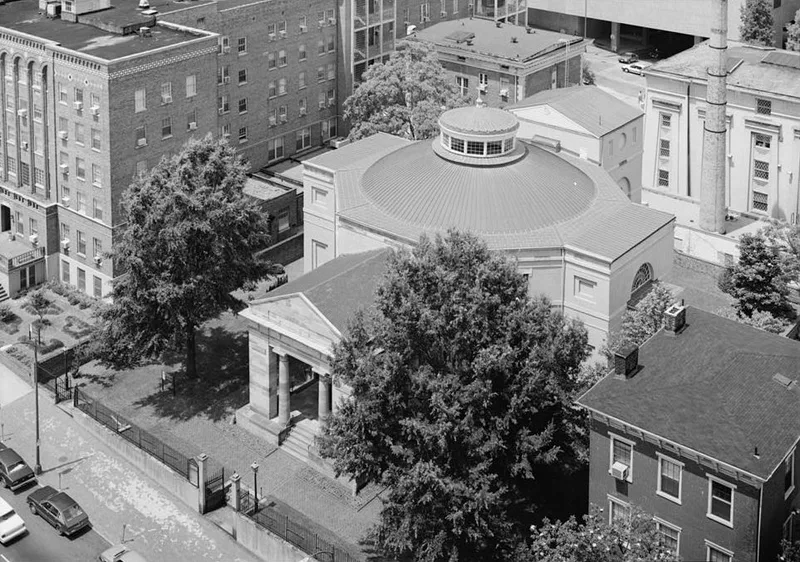
Monumental Church at 1224 E. Broad Street in Richmond was raised in 1812-1814 on the site of a theater that burned on December 26, 1811. Seventy-two people died in the fire, among them Governor George William Smith. John Marshall headed a committee that raised funds by public subscription, and the city contributed $5,000 and the land. Architect Robert Mills gave the building a dual purpose: a stone portico sheltering the memorial, with a stuccoed, two-story octagonal church behind it under a low dome and lantern. The portico's frieze carries lachrymatories in place of triglyphs. The building served as an Episcopal parish church until 1965, when it passed to the Medical College of Virginia, and it now serves as an inter-faith chapel. Its first rector was Richard Channing Moore, later Bishop of Virginia. Later alterations, including stained glass and a remodeled chancel, obscured parts of Mills's original interior.
Significance in brief: It was built as a memorial to the seventy-two people, including Governor George William Smith, who died in a 1811 theater fire on the site, while also serving as a working parish church. It is described as one of America's earliest and most distinctive Greek Revival churches and a milestone in American architecture.
Machine-generated summary. This summary was generated by a language model from the official nomination document and has not been reviewed line by line by an editor. It may contain errors. Check the source document before relying on any detail. Source: nomination document (PDF) · National Archives catalog entry. NRHP reference 69000326, listed April 16, 1969. Summary generated October 2026 (model claude-sonnet-5-5, prompt v1.0-2026-10-29, confidence high).
Key facts
| Address | 1224 E. Broad St., Richmond (Independent City) |
|---|---|
| County | Richmond (city and county) |
| Listed | April 16, 1969 |
| Reference number | 69000326 |
| Resource type | Building |
| Period of significance | 1812-1814 |
| Architect / builder | Robert Mills |
| Architectural style | Greek Revival |
| Areas of significance | Architecture |
| Level of significance | National |
| National Historic Landmark | Yes, designated November 11, 1971 |
| Status (as stated in the nomination) | Occupied; serves as an inter-faith chapel for Medical College students. Portico repaired circa 1965, but the interior was described as much in need of restoration. |
| Acreage | 0.5 |
| Within district | James River and Kanawha Canal Historic District |
| Coordinates | 37.53888, -77.42986 (NPS GIS) |
What listing means for this property
Religious properties are listed for their architectural or historical significance, not their religious use. Listing is honorary and does not restrict the congregation's use of the building. The federal rehabilitation credit is generally unavailable unless part of the building is income-producing; some state programmes and preservation grants do cover religious buildings. Federal funding or permits trigger Section 106 review.
General information, not legal or tax advice. Rules change; confirm with your State Historic Preservation Office or a qualified adviser.
Sources and further reading
- National Park Service, National Register of Historic Places database (snapshot May 2026), reference 69000326.
- Nomination form (PDF, National Archives) — catalog entry
- Wikipedia article (used for cross-checking only; text not reproduced here)
- Wikidata Q6906925
- This listing as JSON
Last updated October 2026. Found an error? See the editorial policy for how to report it.