Forest Hill Park
Also known as: 127-6027; Holden Rhodes House; Boscobel

Why it's listed
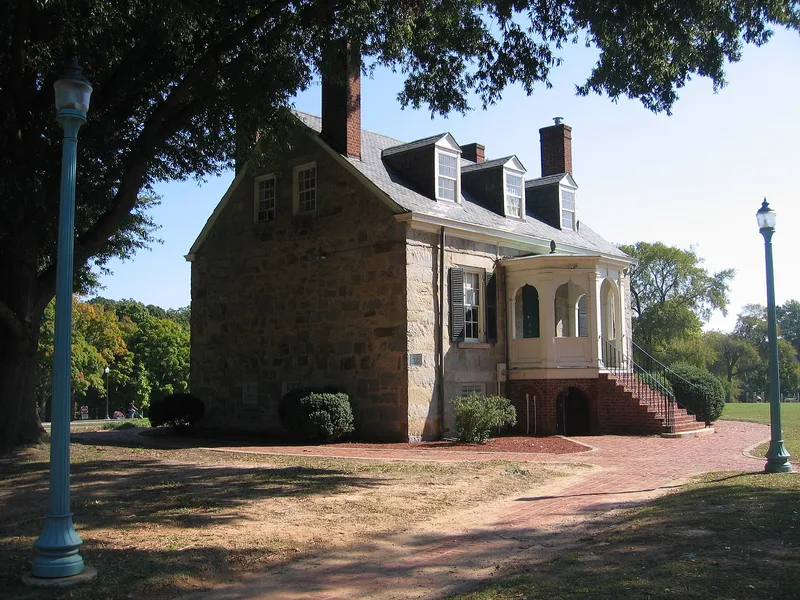
Forest Hill Park is a 105-acre public park on the south side of the James River in Richmond, Virginia, with steep wooded terrain, former granite quarries, a three-acre lake and Reedy Creek. Its centerpiece is a one-and-a-half-story Greek Revival house of locally quarried granite, built between 1836 and 1843 by Holden Rhodes, a businessman and lawyer. In 1889 a land company bought the property and promoted it alongside a new streetcar line to the Woodland Heights suburb. The grounds later became an amusement park at the trolley terminus, and the house held a penny arcade. The City of Richmond acquired the land in 1934. With federal relief funds, architect Ernest R. Gilbert restored the house, and workers built picnic shelters, granite hearths, walkways, a gazebo and a warming hut. The park was listed for its ties to neighborhood development, city parks, Rhodes, and its architecture and landscape.
Significance in brief: The nomination cites Criterion A for the park's link to the Woodland Heights streetcar suburb and to the City of Richmond's park system. Criterion B applies through Holden Rhodes, and Criterion C through the architecture and designed landscape. The 1934 city acquisition and Emergency Relief Administration work shaped the park's present form.
Machine-generated summary. This summary was generated by a language model from the official nomination document and has not been reviewed line by line by an editor. It may contain errors. Check the source document before relying on any detail. Source: nomination document (PDF) · National Archives catalog entry. NRHP reference 02001446, listed November 22, 2002. Summary generated October 2026 (model claude-sonnet-5-5, prompt v1.0-2026-10-29, confidence medium).
Key facts
| Address | Bet. Riverside Dr., Forest Hill Ave., and 42nd St., and 34th St., Richmond (Independent City) |
|---|---|
| County | Richmond (city and county) |
| Listed | November 22, 2002 |
| Reference number | 02001446 |
| Resource type | District |
| Period of significance | 1836-1843, 1934-present |
| Architect / builder | Ernest R. Gilbert (1934 restoration architect) |
| Architectural style | Mid 19th Century: Greek Revival; Late 19th and Early 20th Century American Movements: Craftsman |
| Criteria |
|
| Areas of significance | Architecture, Entertainment/Recreation, Landscape Architecture |
| Level of significance | Local |
| Status (as stated in the nomination) | Current function is landscape/park; the Stone House serves as a focal point for community activities. |
| Acreage | 105.2 |
| Within district | Forest Hill Historic District |
| Coordinates | 37.51998, -77.47306 (NPS GIS) |
What listing means for this property
This is a historic district. Buildings within its boundary are either contributing (they add to the district's significance) or non-contributing. Owners of contributing income-producing buildings can claim the 20% federal rehabilitation tax credit; homeowners should look at state credits. National Register districts impose no design review by themselves; a local historic district ordinance, if one exists, does (the difference explained).
General information, not legal or tax advice. Rules change; confirm with your State Historic Preservation Office or a qualified adviser.
Sources and further reading
- National Park Service, National Register of Historic Places database (snapshot May 2026), reference 02001446.
- Nomination form (PDF, National Archives) — catalog entry
- Wikipedia article (used for cross-checking only; text not reproduced here)
- Wikidata Q5468937
- This listing as JSON
Last updated October 2026. Found an error? See the editorial policy for how to report it.