Armitage Manufacturing Company
Also known as: Fibre Board Container Company / VDHR No. 127-6693

Why it's listed
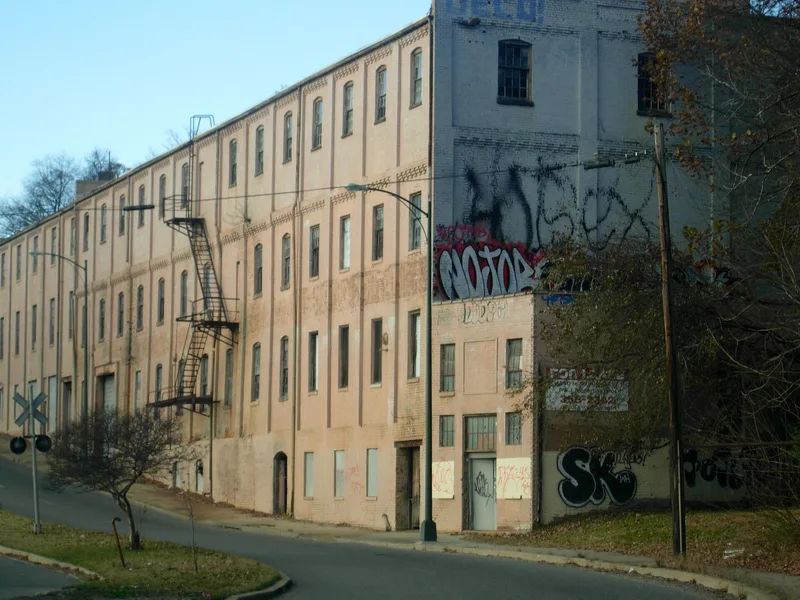
Built in 1900 on Williamsburg Avenue in Richmond's East End, this brick industrial building began as the Armitage Manufacturing Company plant, designed by the Richmond firm Noland & Baskervill. Armitage made roofing paper and building materials using coal tar from the Fulton Gas Works across the street. After the company went bankrupt, the Fibre Board Container Company took over in 1916 and made corrugated shipping boxes, with Richmond's tobacco and cigarette makers among its clients. Contractor James Fox & Sons carried out additions between 1924 and 1939 that more than doubled the building's size, and a large bowstring truss wing for paper storage followed in the 1950s. The front wing keeps its heavy timber framing, corbelled cornice, pilasters and stepped end walls. The property was recognized for its place in the city's industrial history and as an intact early industrial design. It has been used mainly for warehouse storage since the 1960s.
Significance in brief: It is significant under Criterion A for its role in Richmond's manufacturing industry from 1900 to 1956, first making roofing paper and building supplies from gas works tar and later corrugated shipping containers for the tobacco trade. It is significant under Criterion C as turn-of-the-century heavy-timber industrial construction and the earliest industrial design by Noland & Baskervill.
Machine-generated summary. This summary was generated by a language model from the official nomination document and has not been reviewed line by line by an editor. It may contain errors. Check the source document before relying on any detail. Source: nomination document (PDF) · National Archives catalog entry. NRHP reference 12000545, listed August 22, 2012. Summary generated October 2026 (model claude-sonnet-5-5, prompt v1.0-2026-10-29, confidence high).
Key facts
| Address | 3200 Williamsburg Ave., Richmond (Independent City) |
|---|---|
| County | Richmond (city and county) |
| Listed | August 22, 2012 |
| Reference number | 12000545 |
| Resource type | Building |
| Period of significance | 1900-1956 |
| Architect / builder | Noland & Baskervill; James Fox & Sons |
| Architectural style | OTHER: Industrial |
| Criteria |
|
| Areas of significance | Architecture, Industry |
| Level of significance | Local |
| Status (as stated in the nomination) | Used mainly as warehouse storage since the plant closed in the 1960s; the form lists current function as vacant. |
| Acreage | 4.6 |
| Within district | St. John's Church Historic District |
| Coordinates | 37.52670, -77.41537 (NPS GIS) |
What listing means for this property
For an income-producing building, listing (individually or as a contributing building in a district) is the gateway to the 20% federal rehabilitation tax credit on qualified rehabilitation costs, often stackable with state credits. Work claiming the credit must follow the Secretary of the Interior's Standards and be approved in advance.
Listing does not restrict a private owner acting without federal money or permits; where federal funding or licensing is involved, Section 106 review applies.
Noted as vacant in the nomination. Nomination documents can be decades old; current status may differ. If you are considering buying an empty listed property, read the due-diligence checklist.
General information, not legal or tax advice. Rules change; confirm with your State Historic Preservation Office or a qualified adviser.
Sources and further reading
- National Park Service, National Register of Historic Places database (snapshot May 2026), reference 12000545.
- Nomination form (PDF, National Archives) — catalog entry
- Wikipedia article (used for cross-checking only; text not reproduced here)
- Wikidata Q16161622
- This listing as JSON
Last updated October 2026. Found an error? See the editorial policy for how to report it.