Belle-Hampton
Also known as: Hayfield; 77-3

Why it's listed
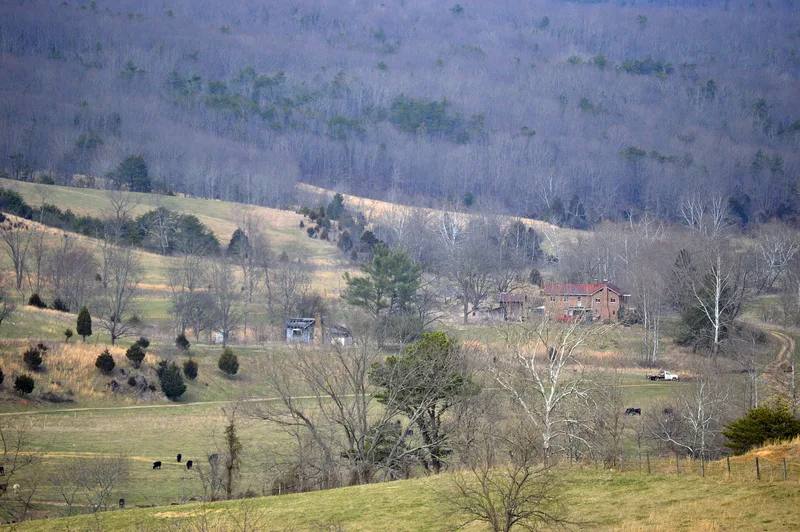
Belle-Hampton is a farm and industrial complex in northern Pulaski County, Virginia, set on a terrace below Cloyd's Mountain and overlooking bottomland along Back Creek. The brick main house was built about 1826 by General James Hoge to replace his father's log dwelling, then enlarged around 1879 by his grandson James Hoge Tyler with a large Italianate addition that covered the original front. Around the house stand a brick kitchen and slave house, a meathouse, a possible blacksmith shop, a bank barn, a granary and a 1931 swimming pool and tennis court. Tyler, an industrialist and agricultural promoter, later served as governor of Virginia from 1898 to 1902. He also ran a coal mine on the property, and a large brick building that may have served as a store and post office survives from that venture. The nomination values the complex for its integrity, its mining history, its Tyler connection and its well-preserved antebellum farm.
Significance in brief: The property is argued to be significant for its link to a private coal-mining operation (Criterion A) and as the home, farm and industrial base of James Hoge Tyler, Governor of Virginia from 1898 to 1902 (Criterion B). It is also cited as an unusually well-preserved and complete antebellum farm in Southwest Virginia, whose house additions show how a family changed its living environment over time (Criterion C).
Machine-generated summary. This summary was generated by a language model from the official nomination document and has not been reviewed line by line by an editor. It may contain errors. Check the source document before relying on any detail. Source: nomination document (PDF) · National Archives catalog entry. NRHP reference 89001911, listed November 13, 1989. Summary generated October 2026 (model claude-sonnet-5-5, prompt v1.0-2026-10-29, confidence high).
Key facts
| Address | VA 627, 0.3 mi. N of VA 617, Dublin |
|---|---|
| County | Pulaski County |
| Listed | November 13, 1989 |
| Reference number | 89001911 |
| Resource type | Building |
| Period of significance | 1826-1939 |
| Architect / builder | unknown |
| Architectural style | Early Republic: Federal; Late Victorian: Italianate |
| Criteria |
|
| Areas of significance | Agriculture, Politics/Government, Architecture |
| Level of significance | State |
| Status (as stated in the nomination) | Farm still used for cattle grazing; the original house serves as an unheated summer house and the brick outbuilding as a second home. The form's current functions also list vacant/not in use. |
| Acreage | 253 |
| Coordinates | 37.17914, -80.66188 (NPS GIS) |
What listing means for this property
National Register listing is honorary: it recognises significance and does not restrict what a private owner may do without federal money or permits. It unlocks the 20% federal rehabilitation tax credit for income-producing buildings, state credits in many states, and Section 106 review when federal agencies are involved. See what listing means in practice.
General information, not legal or tax advice. Rules change; confirm with your State Historic Preservation Office or a qualified adviser.
Sources and further reading
- National Park Service, National Register of Historic Places database (snapshot May 2026), reference 89001911.
- Nomination form (PDF, National Archives) — catalog entry
- Wikipedia article (used for cross-checking only; text not reproduced here)
- Wikidata Q15198268
- This listing as JSON
Last updated October 2026. Found an error? See the editorial policy for how to report it.