Buckland Historic District
Also known as: DHL File No. 76--313

Why it's listed
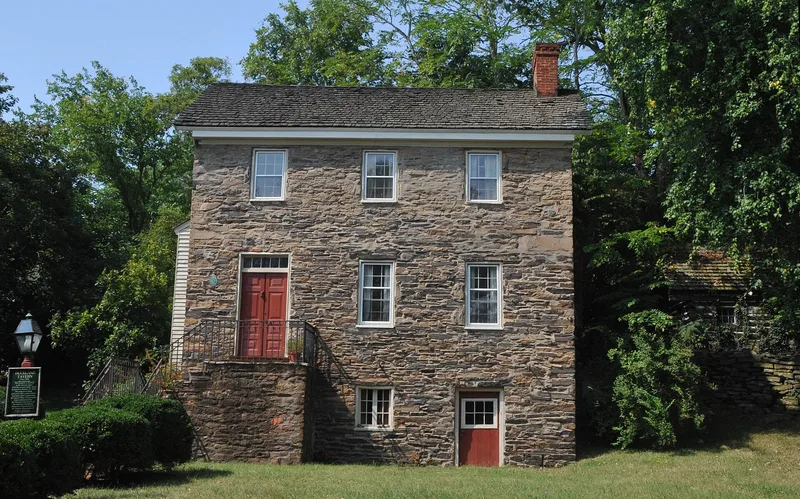
Buckland is a small rural village on Broad Run in Prince William County, Virginia, laid out by John Love and chartered in 1798 as the county's first inland town. The historic district covers about 19.6 acres and 21 buildings, centered on a mill site that has held three mills since the 1790s. The present frame grist mill, Calvert's Mill, dates from about 1899 and closed in 1919. Nearby are a stone wagon tavern from the early 19th century, a blacksmith's house, small log, frame and stone dwellings that once combined homes with shops, and a Methodist church built in 1857 with its churchyard cemetery. Buckland was an important wagon stop on the road between Alexandria and the land beyond the Blue Ridge, and was once nicknamed the Lowell of Prince William County for its woolen mill. The district was listed because it keeps an unusually complete picture of a Piedmont mill community, with few intrusive modern changes despite the nearby divided highway.
Significance in brief: The nomination presents the district as a representative small, mill-oriented Piedmont community of the late 18th through 19th centuries. Buckland was the first inland town established in Prince William County and an important wagon stop on the road between Alexandria and the territory beyond the Blue Ridge. The mill and village keep an unusually complete sense of their original character and appearance.
Machine-generated summary. This summary was generated by a language model from the official nomination document and has not been reviewed line by line by an editor. It may contain errors. Check the source document before relying on any detail. Source: nomination document (PDF) · National Archives catalog entry. NRHP reference 88000681, listed June 17, 1988. Summary generated October 2026 (model claude-sonnet-5-5, prompt v1.0-2026-10-29, confidence medium).
Key facts
| Address | 7980--8205 Buckland Mill Rd. and 16206, 16208, 16210, and 16211 Lee Hwy., Buckland |
|---|---|
| County | Prince William County |
| Listed | June 17, 1988 |
| Reference number | 88000681 |
| Resource type | District |
| Period of significance | ca. 1800 - 1930s |
| Architectural style | Vernacular (19th century) |
| Areas of significance | Industry, Transportation, Architecture |
| Level of significance | State |
| Status (as stated in the nomination) | Most contributing buildings are in good to excellent condition; two are deteriorated, and one of those is being renovated. The district is now almost entirely residential. The mill closed in 1919 and is disused. |
| Acreage | 19.6 |
| Coordinates | 38.78094, -77.67402 (NPS GIS) |
What listing means for this property
This is a historic district. Buildings within its boundary are either contributing (they add to the district's significance) or non-contributing. Owners of contributing income-producing buildings can claim the 20% federal rehabilitation tax credit; homeowners should look at state credits. National Register districts impose no design review by themselves; a local historic district ordinance, if one exists, does (the difference explained).
General information, not legal or tax advice. Rules change; confirm with your State Historic Preservation Office or a qualified adviser.
Sources and further reading
- National Park Service, National Register of Historic Places database (snapshot May 2026), reference 88000681.
- Nomination form (PDF, National Archives) — catalog entry
- Wikipedia article (used for cross-checking only; text not reproduced here)
- Wikidata Q15205491
- This listing as JSON
Last updated October 2026. Found an error? See the editorial policy for how to report it.