Buffalo Presbyterian Church
Also known as: VDHR File No. 73-28

Why it's listed
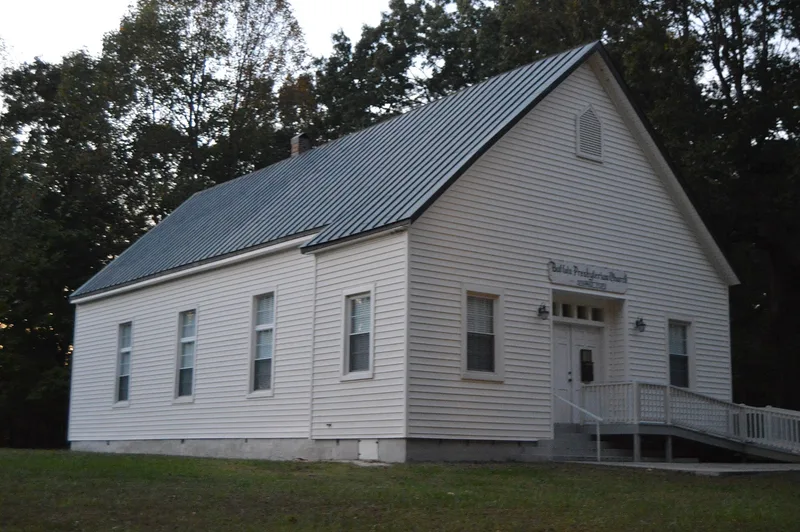
Buffalo Presbyterian Church is a plain, weatherboarded frame meetinghouse on a rural road near Pamplin, Virginia, with a cemetery beside it. The congregation formed in 1739 and moved half a mile to this site in 1804, after fire destroyed an earlier building. The core of the church measures 50 by 26 feet and has a standing seam metal gable roof and nine-over-nine windows. Early in the twentieth century the entrance was turned to the east, the gallery removed and an apse added, and in 1931 a vestibule with two small classrooms was built. Inside, paneled box pews, wood floors, a plank ceiling and two cast iron wood stoves survive. The church is valued as a typical but increasingly rare example of an early-nineteenth-century rural church. Its congregation is the oldest extant Presbyterian group in Southside Virginia, and in 1776 it was the first to petition the General Assembly to disestablish the Church of England.
Significance in brief: The nomination argues the church is a typical but increasingly rare example of an early-nineteenth-century vernacular, frame, meetinghouse-style rural church that retains its integrity despite early twentieth-century changes. Its congregation, formed in 1739, is the earliest extant Presbyterian congregation in Southside Virginia. It also petitioned the General Assembly in 1776 to disestablish the Church of England.
Machine-generated summary. This summary was generated by a language model from the official nomination document and has not been reviewed line by line by an editor. It may contain errors. Check the source document before relying on any detail. Source: nomination document (PDF) · National Archives catalog entry. NRHP reference 95000395, listed April 7, 1995. Summary generated October 2026 (model claude-sonnet-5-5, prompt v1.0-2026-10-29, confidence high).
Key facts
| Address | VA 659, 0.3 mi. S of jct. with VA 658, Pamplin |
|---|---|
| County | Prince Edward County |
| Listed | April 7, 1995 |
| Reference number | 95000395 |
| Resource type | Building |
| Period of significance | c. 1804-1920 |
| Architectural style | Early Republic; Other: Vernacular |
| Criteria |
|
| Areas of significance | Architecture |
| Level of significance | Local |
| Status (as stated in the nomination) | Still used as an active church with a well-maintained cemetery; the building has no plumbing or heating systems apart from two wood-burning stoves. |
| Acreage | 4.7 |
| Coordinates | 37.24052, -78.60054 (NPS GIS) |
What listing means for this property
Religious properties are listed for their architectural or historical significance, not their religious use. Listing is honorary and does not restrict the congregation's use of the building. The federal rehabilitation credit is generally unavailable unless part of the building is income-producing; some state programmes and preservation grants do cover religious buildings. Federal funding or permits trigger Section 106 review.
General information, not legal or tax advice. Rules change; confirm with your State Historic Preservation Office or a qualified adviser.
Sources and further reading
- National Park Service, National Register of Historic Places database (snapshot May 2026), reference 95000395.
- Nomination form (PDF, National Archives) — catalog entry
- Wikipedia article (used for cross-checking only; text not reproduced here)
- Wikidata Q4985814
- This listing as JSON
Last updated October 2026. Found an error? See the editorial policy for how to report it.