Lovingston Historic District
Also known as: Vdhr 062-5108
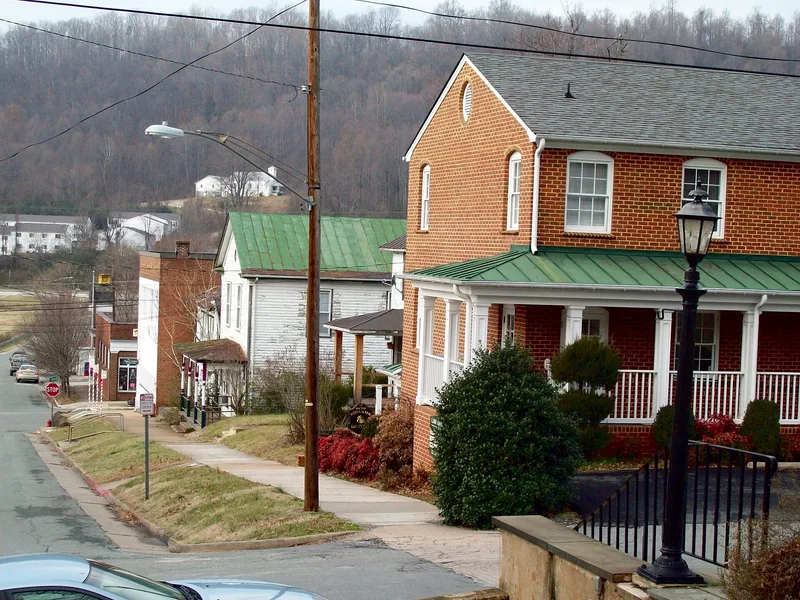

Why it's listed
Lovingston is the county seat village of Nelson County, Virginia, and its historic district covers 224.8 acres along Front Street and around the courthouse square. Land donated by county commissioner James Loving was platted in 1809 on a grid with a courthouse lot and forty-nine additional lots, and the plan was extended south in 1823. The village grew along the Lynchburg Stage Road, the main tobacco trade route between Charlottesville and Lynchburg, and taverns, hotels, offices and homes followed. Its unusual two-center pattern pairs the governmental courthouse square with the commercial Front Street. The district holds about 175 resources, including the 1809 courthouse, a Jefferson-designed jail built in 1823 by mason William B. Phillips, a 1937 Colonial Revival jail, the Federal-style Stage Inn, and many houses and commercial buildings in Greek Revival, Italianate, Colonial Revival and Craftsman styles. It was listed for its role in local government, transportation and community development, and for its architecture.
Significance in brief: The district is significant for its role as the government and commercial center of Nelson County and for its linear growth along an important Charlottesville-to-Lynchburg travel route. It also contains a wide range of architectural styles, including an early courthouse plan and a jail based on a Thomas Jefferson design.
Machine-generated summary. This summary was generated by a language model from the official nomination document and has not been reviewed line by line by an editor. It may contain errors. Check the source document before relying on any detail. Source: nomination document (PDF) · National Archives catalog entry. NRHP reference 05001232, listed November 9, 2005. Summary generated October 2026 (model claude-sonnet-5-5, prompt v1.0-2026-10-29, confidence medium).
Key facts
| Address | VA 56 (Front St.) from Orchard Rd. (N) to Sunset Ln. (S), Parallel to US 29, Lovingston |
|---|---|
| County | Nelson County |
| Listed | November 9, 2005 |
| Reference number | 05001232 |
| Resource type | District |
| Period of significance | c. 1809-1955 |
| Architect / builder | Crosthwait, Shelton; Jefferson, Thomas; Phillips, William B.; Varnum, George W. |
| Architectural style | Federal, Greek Revival, Gothic Revival, Italianate, Queen Anne, Colonial Revival, Bungalow/Craftsman, Commercial Style, and Modern Movement (Art Deco, Moderne); some resources have no style |
| Criteria |
|
| Areas of significance | Architecture, Community Planning and Development, Politics/Government, Transportation |
| Level of significance | Local |
| Status (as stated in the nomination) | The 1809 courthouse remains in use, and the 1823 jail now serves as a sheriff's office. The current functions list a theater and processing/storage buildings as vacant or not in use. |
| Acreage | 224.8 |
| Coordinates | 37.76371, -78.86397 (NPS GIS) |
What listing means for this property
This is a historic district. Buildings within its boundary are either contributing (they add to the district's significance) or non-contributing. Owners of contributing income-producing buildings can claim the 20% federal rehabilitation tax credit; homeowners should look at state credits. National Register districts impose no design review by themselves; a local historic district ordinance, if one exists, does (the difference explained).
General information, not legal or tax advice. Rules change; confirm with your State Historic Preservation Office or a qualified adviser.
Sources and further reading
- National Park Service, National Register of Historic Places database (snapshot May 2026), reference 05001232.
- Nomination form (PDF, National Archives) — catalog entry
- Wikipedia article (used for cross-checking only; text not reproduced here)
- Wikidata Q6692642
- This listing as JSON
Last updated October 2026. Found an error? See the editorial policy for how to report it.