Johnson, Dr. Robert Walker, House and Tennis Court
Also known as: VDHR no. 118-0225-0077

Why it's listed
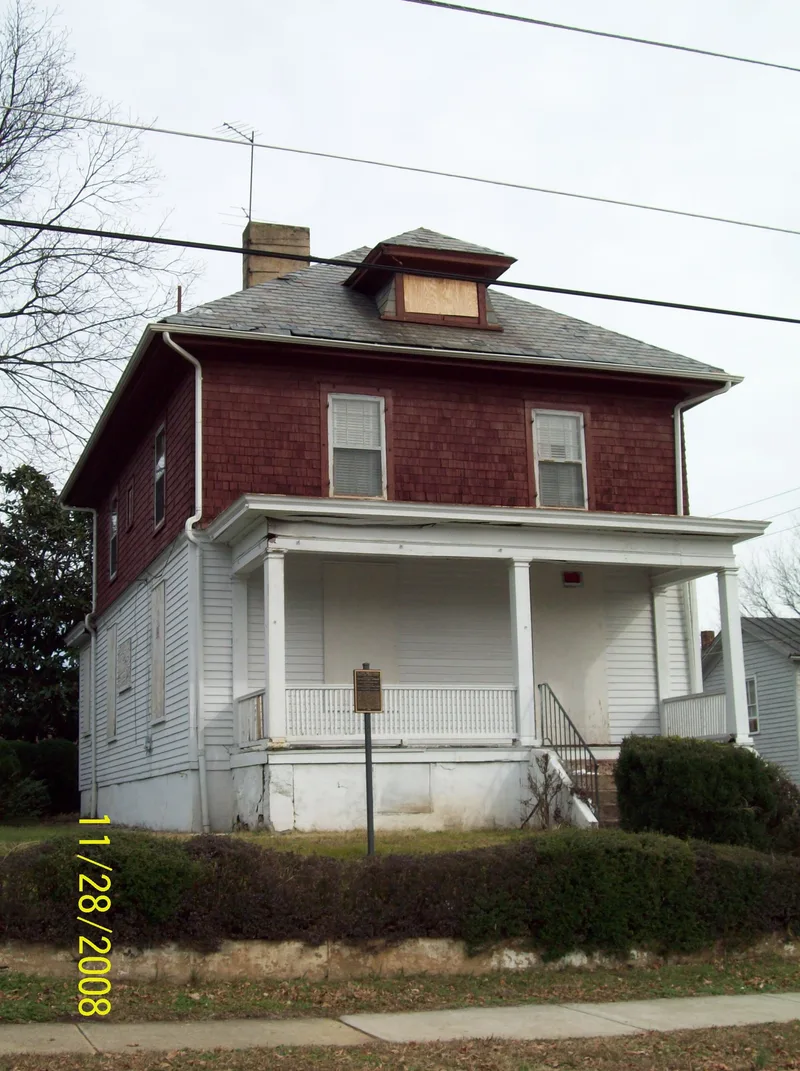
This property in Lynchburg's South Diamond Hill neighborhood combines a 1911 American Foursquare house, a rear garage, and the site of a clay tennis court built in the 1930s. Architect James T. McLaughlin designed the two-story frame house, which has a hipped roof, a front dormer and a full-width porch. The adjacent raised lot still shows the court's grading and two metal net posts, along with a small commemorative marker. Dr. Robert Walter Johnson, a surgeon who came to Lynchburg in 1933, built the court and used it for a summer tennis camp. As a leader in the American Tennis Association and founder of its Junior Development Program, he recruited young Black players, housed and equipped them, and drove them to tournaments along the East Coast. Althea Gibson and Arthur Ashe were among those he coached and supported. The property was listed for its links to Johnson's work in recreation and Black achievement between 1933 and 1971.
Significance in brief: Dr. Robert Walter Johnson, a Black surgeon and civil rights figure, built the tennis court after arriving in Lynchburg in 1933 and ran a summer tennis camp here. Through the American Tennis Association's Junior Development Program he trained and supported young African American players, including Althea Gibson and Arthur Ashe. The nomination argues national significance in recreation and ethnic heritage.
Machine-generated summary. This summary was generated by a language model from the official nomination document and has not been reviewed line by line by an editor. It may contain errors. Check the source document before relying on any detail. Source: nomination document (PDF) · National Archives catalog entry. NRHP reference 01001519, listed January 24, 2002. Summary generated October 2026 (model claude-sonnet-5-5, prompt v1.0-2026-10-29, confidence high).
Key facts
| Address | 1422 Pierce St., Lynchburg (Independent City) |
|---|---|
| County | Lynchburg |
| Listed | January 24, 2002 |
| Reference number | 01001519 |
| Resource type | Building |
| Period of significance | 1933-1971 |
| Architect / builder | McLaughlin, James T. |
| Architectural style | Late 19th and Early 20th Century American Movements: American Foursquare |
| Criteria |
|
| Areas of significance | Entertainment/Recreation, Black |
| Level of significance | National |
| Status (as stated in the nomination) | The house and garage are described as in excellent condition with a high level of integrity. The tennis court's fencing, nets, lights and scoreboard are gone, but the grading and metal net posts remain. The form lists the current function as vacant or not in use. |
| Acreage | 0.9 |
| Coordinates | 37.41197, -79.15026 (NPS GIS) |
What listing means for this property
National Register listing is honorary for a privately owned home: it does not by itself restrict what an owner may do with their own money, and it does not require public access. Restrictions come from local landmark or historic-district ordinances, which are separate (how they differ).
Owner-occupied houses are not eligible for the 20% federal rehabilitation tax credit, which applies to income-producing buildings, but many states offer credits for homeowners. Listing also opens the door to preservation easements and to buying a plaque. Start with what listing means for homeowners, renovating a listed house and selling one.
Noted as vacant in the nomination. Nomination documents can be decades old; current status may differ. If you are considering buying an empty listed property, read the due-diligence checklist.
General information, not legal or tax advice. Rules change; confirm with your State Historic Preservation Office or a qualified adviser.
Sources and further reading
- National Park Service, National Register of Historic Places database (snapshot May 2026), reference 01001519.
- Nomination form (PDF, National Archives) — catalog entry
- Wikipedia article (used for cross-checking only; text not reproduced here)
- Wikidata Q5304352
- This listing as JSON
Last updated October 2026. Found an error? See the editorial policy for how to report it.