Diamond Hill Baptist Church
Also known as: Vhdr Id 118-0060-0057

Why it's listed
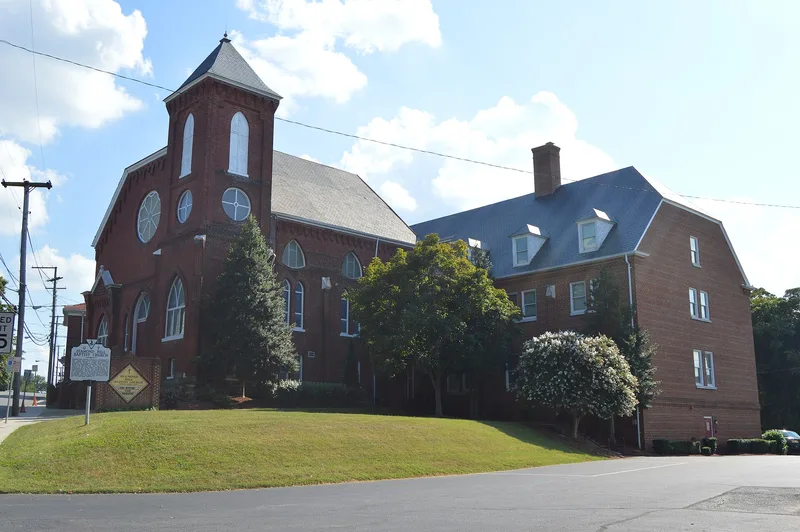
Diamond Hill Baptist Church is a red brick Gothic Revival building on Grace Street in Lynchburg, begun in 1886 by an African American congregation. Mason Lewis Bolling did the brickwork. Features include pointed arch stained glass windows, limestone-capped buttresses, a slate jerkinhead roof, a three-story tower and a sanctuary with a wraparound balcony. The original design allowed the building to be sold as a theater if the congregation could not pay for it. The interior was remodeled in 1903, a parsonage was built in 1951, and a matching addition followed in 1993. The congregation, founded in 1872, is the city's second oldest Black church. It became a center of civil rights activity between 1958 and 1963 under Rev. Virgil Wood, who founded the Lynchburg Improvement Association. Mass meetings, voter drives, and planning for school integration and lunch counter desegregation took place here. The church is still used for worship.
Significance in brief: The church was the city's second oldest African American church and a center of civil rights activity from 1958 to 1963 under Rev. Virgil Wood. It hosted mass meetings, voter registration drives and planning for school integration and lunch counter desegregation. It also reflects the growth of Black churches after the end of slavery.
Machine-generated summary. This summary was generated by a language model from the official nomination document and has not been reviewed line by line by an editor. It may contain errors. Check the source document before relying on any detail. Source: nomination document (PDF) · National Archives catalog entry. NRHP reference 11000026, listed February 22, 2011. Summary generated October 2026 (model claude-sonnet-5-5, prompt v1.0-2026-10-29, confidence medium).
Key facts
| Address | 1415 Grace St, Lynchburg |
|---|---|
| County | Lynchburg |
| Listed | February 22, 2011 |
| Reference number | 11000026 |
| Resource type | Building |
| Period of significance | 1958-1963 |
| Architect / builder | Lewis Bolling, mason |
| Architectural style | Late 19th and 20th Century Revivals: Late Gothic Revival |
| Criteria |
|
| Areas of significance | Black |
| Level of significance | Local |
| Status (as stated in the nomination) | Still used for religious purposes; the church and an adjacent parsonage remain in use. |
| Acreage | 0.9 |
| Within district | Diamond Hill Historic District (Boundary Increase) |
| Coordinates | 37.40948, -79.14335 (NPS GIS) |
What listing means for this property
Religious properties are listed for their architectural or historical significance, not their religious use. Listing is honorary and does not restrict the congregation's use of the building. The federal rehabilitation credit is generally unavailable unless part of the building is income-producing; some state programmes and preservation grants do cover religious buildings. Federal funding or permits trigger Section 106 review.
General information, not legal or tax advice. Rules change; confirm with your State Historic Preservation Office or a qualified adviser.
Sources and further reading
- National Park Service, National Register of Historic Places database (snapshot May 2026), reference 11000026.
- Nomination form (PDF, National Archives) — catalog entry
- Wikipedia article (used for cross-checking only; text not reproduced here)
- Wikidata Q16829601
- This listing as JSON
Last updated October 2026. Found an error? See the editorial policy for how to report it.