Jones Farm
Also known as: VDHR File No. 55-182

Why it's listed
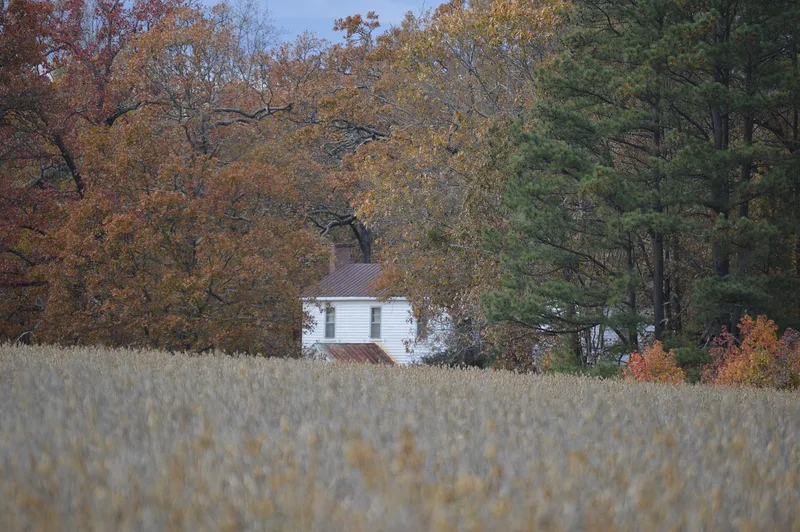
Jones Farm is a 359-acre tobacco farm along Flat Rock Creek in eastern Lunenburg County, Virginia. Its main house began as a two-story brick-founded ell built around 1835 and was joined by a symmetrical, three-bay I-house recorded in 1846. The house has Greek Revival features, including a pedimented front porch, and it retains original weatherboard, mortise-and-tenon doors, rim locks, fireplaces and mantels. Around it stand an icehouse, smokehouse, granary, stable, corncribs, chicken houses, five tobacco barns and three tenant farmhouses. L. C. Jones assembled the property from the 1830s to 1846, and by 1840 the farm supported 21 people, including 16 enslaved people. After the Civil War it relied on tenant farming into the 1960s. The farm was recognized for its architecture and its record of agriculture, with a period of significance from 1840 to 1945. It remains in family descent and in production today.
Significance in brief: The farm is presented as a well-preserved example of a successful Southside Virginia tobacco farm from the mid-nineteenth into the twentieth century. Its dwelling has changed little since about 1846, and most outbuildings survive. It also documents the shift from a slave-era economy to tenant farming.
Machine-generated summary. This summary was generated by a language model from the official nomination document and has not been reviewed line by line by an editor. It may contain errors. Check the source document before relying on any detail. Source: nomination document (PDF) · National Archives catalog entry. NRHP reference 96001052, listed September 27, 1996. Summary generated October 2026 (model claude-sonnet-5-5, prompt v1.0-2026-10-29, confidence high).
Key facts
| Address | VA 609, approximately .75 mi. N of jct. with VA 613, Kenbridge |
|---|---|
| County | Lunenburg County |
| Listed | September 27, 1996 |
| Reference number | 96001052 |
| Resource type | Building |
| Period of significance | 1840-1945 |
| Architectural style | Mid-19th Century: Greek Revival |
| Criteria |
|
| Areas of significance | Architecture, Agriculture |
| Level of significance | Local |
| Status (as stated in the nomination) | The main house is a single dwelling and the land is still farmed for tobacco, other crops and cattle. The three tenant farmhouses are unoccupied and in poor repair, and the tobacco storage building is nearly in ruins. |
| Acreage | 359 |
| Coordinates | 36.89521, -78.11242 (NPS GIS) |
What listing means for this property
National Register listing is honorary for a privately owned home: it does not by itself restrict what an owner may do with their own money, and it does not require public access. Restrictions come from local landmark or historic-district ordinances, which are separate (how they differ).
Owner-occupied houses are not eligible for the 20% federal rehabilitation tax credit, which applies to income-producing buildings, but many states offer credits for homeowners. Listing also opens the door to preservation easements and to buying a plaque. Start with what listing means for homeowners, renovating a listed house and selling one.
General information, not legal or tax advice. Rules change; confirm with your State Historic Preservation Office or a qualified adviser.
Sources and further reading
- National Park Service, National Register of Historic Places database (snapshot May 2026), reference 96001052.
- Nomination form (PDF, National Archives) — catalog entry
- Wikipedia article (used for cross-checking only; text not reproduced here)
- Wikidata Q14712639
- This listing as JSON
Last updated October 2026. Found an error? See the editorial policy for how to report it.