Waterford Historic District
Also known as: Waterford; Vdhr# 401-0123

Why it's listed
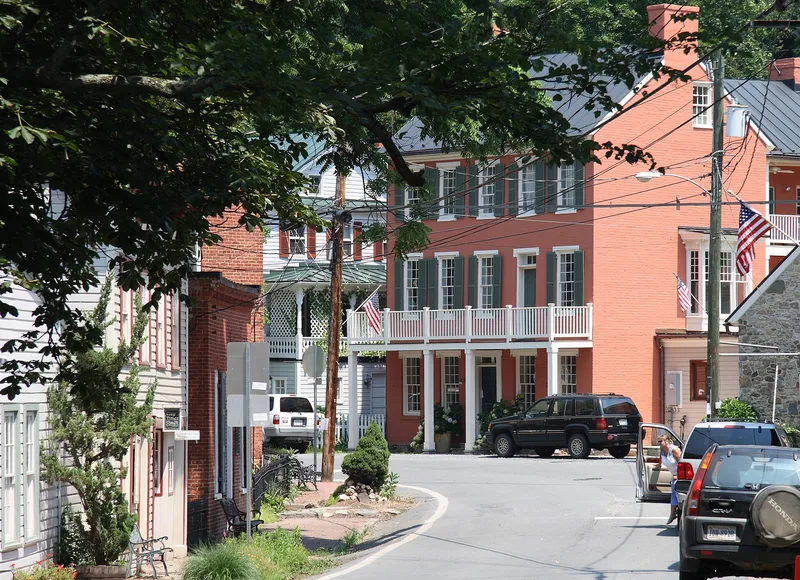
Waterford is a mill village in the Loudoun Valley, seven miles northwest of Leesburg. Founded as a small Quaker settlement about 1730, it is the oldest settlement in Loudoun County. The first house built within the town limits, that of Asa Moore (c.1733), still stands. The village was first called Milltown for its small industries, then renamed for Waterford, Ireland. It was incorporated in 1810, and by 1834 had about four hundred residents, seventy houses, a tannery, a chair-maker and a boot and shoe manufacturer. Buildings use brick, stone, log and frame, and include a brick mill (c.1750), the Arch House Row (c.1750), the log Camelot School (c.1800), a neo-classic Baptist Church of 1850 and a Victorian Presbyterian Church of 1882. The surrounding open, rolling landscape adds to the village's character. Careful private preservation has kept most of Waterford much as it was in the nineteenth century.
Significance in brief: Waterford is the oldest settlement in Loudoun County, founded as a Quaker village about 1730. It remains virtually unchanged from its eighteenth and nineteenth century appearance, with a wide variety of building materials and architectural styles, set in an unspoiled rolling landscape.
Machine-generated summary. This summary was generated by a language model from the official nomination document and has not been reviewed line by line by an editor. It may contain errors. Check the source document before relying on any detail. Source: nomination document (PDF) · National Archives catalog entry. NRHP reference 69000256, listed June 3, 1969. Summary generated October 2026 (model claude-sonnet-5-5, prompt v1.0-2026-10-29, confidence medium).
Key facts
| Address | NW of Leesburg on Rte. 665, Waterford |
|---|---|
| County | Loudoun County |
| Listed | June 3, 1969 |
| Reference number | 69000256 |
| Resource type | District |
| Period of significance | 18th and 19th centuries |
| Architectural style | Varied styles, including neo-classic (Baptist Church, 1850) and Victorian (Presbyterian Church, 1882) |
| Areas of significance | Commerce, Exploration/Settlement, Architecture, Religion |
| Level of significance | National, State |
| National Historic Landmark | Yes, designated April 15, 1970 |
| Status (as stated in the nomination) | Condition listed as fair; most of the village remains as it was in the nineteenth century through private preservation efforts. Form marks it as occupied with preservation work in progress. |
| Coordinates | 39.18482, -77.61366 (NPS GIS) |
What listing means for this property
This is a historic district. Buildings within its boundary are either contributing (they add to the district's significance) or non-contributing. Owners of contributing income-producing buildings can claim the 20% federal rehabilitation tax credit; homeowners should look at state credits. National Register districts impose no design review by themselves; a local historic district ordinance, if one exists, does (the difference explained).
General information, not legal or tax advice. Rules change; confirm with your State Historic Preservation Office or a qualified adviser.
Sources and further reading
- National Park Service, National Register of Historic Places database (snapshot May 2026), reference 69000256.
- Nomination form (PDF, National Archives) — catalog entry
- Wikipedia article (used for cross-checking only; text not reproduced here)
- Wikidata Q2552551
- This listing as JSON
Last updated October 2026. Found an error? See the editorial policy for how to report it.