Chelsea

Why it's listed
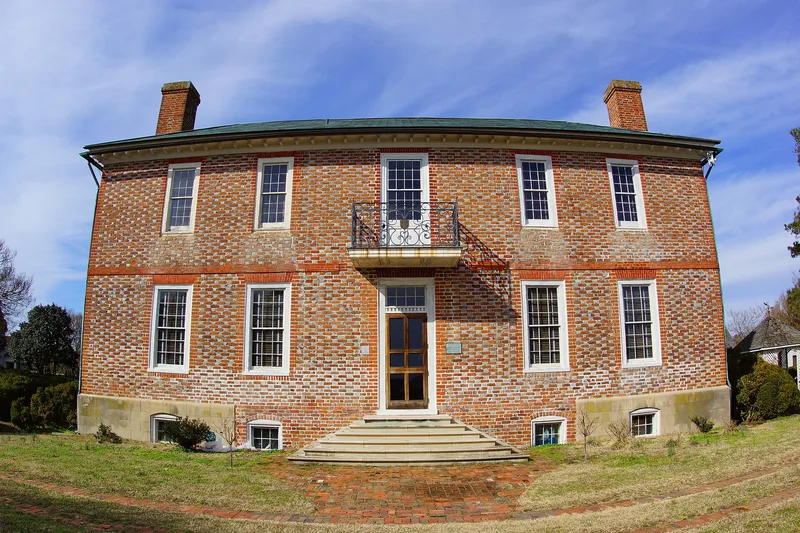
Chelsea is a brick house on the west bank of the Mattaponi River in King William County, Virginia, thought to have been built around 1709 by planter Augustine Moore. Its two-story main block has a T-shaped plan with a hipped roof, modillioned cornice and Flemish bond brickwork, including glazed headers, rubbed brick belt course and rubbed arches. A gambrel-roofed rear ell extends to the west. Inside, the central hall is panelled in walnut and flanked by pine-panelled rooms with Doric pilasters and a slender-balustered stair. The house is tied to several events: Governor Spotswood and his Knights of the Golden Horse Shoe set out from here in 1716, and in 1781 Lafayette's army camped at the property and used the house as headquarters. It remained with the Moore family until about 1874. The brickwork ranks among the best in Virginia, and the shallow plan shows an early variation in Virginia house design.
Significance in brief: The nomination ranks the brickwork among the best in Virginia and notes that the fine interior panelling relates to mansions such as Wilton and Tazewell Hall. Its shallow single-room-deep plan is an unusual example of housebuilding before the two-room-deep plan became standard. It also has historical associations with Governor Spotswood's 1716 expedition and with Lafayette's 1781 headquarters.
Machine-generated summary. This summary was generated by a language model from the official nomination document and has not been reviewed line by line by an editor. It may contain errors. Check the source document before relying on any detail. Source: nomination document (PDF) · National Archives catalog entry. NRHP reference 69000253, listed November 12, 1969. Summary generated October 2026 (model claude-sonnet-5-5, prompt v1.0-2026-10-29, confidence high).
Key facts
| Address | N of jct. of Chelsea Rd. and Rte. 30, West Point |
|---|---|
| County | King William County |
| Listed | November 12, 1969 |
| Reference number | 69000253 |
| Resource type | Building |
| Period of significance | 18th Century |
| Architect / builder | Augustine Moore (believed builder) |
| Areas of significance | Architecture, Social History |
| Level of significance | State |
| Status (as stated in the nomination) | Listed as occupied, in private residential use, in good condition; the form says the property is not open to the public. |
| Acreage | 510.5 |
| Coordinates | 37.59680, -76.82914 (NPS GIS) |
What listing means for this property
National Register listing is honorary: it recognises significance and does not restrict what a private owner may do without federal money or permits. It unlocks the 20% federal rehabilitation tax credit for income-producing buildings, state credits in many states, and Section 106 review when federal agencies are involved. See what listing means in practice.
General information, not legal or tax advice. Rules change; confirm with your State Historic Preservation Office or a qualified adviser.
Sources and further reading
- National Park Service, National Register of Historic Places database (snapshot May 2026), reference 69000253.
- Nomination form (PDF, National Archives) — catalog entry
- Wikipedia article (used for cross-checking only; text not reproduced here)
- Wikidata Q14712159
- This listing as JSON
Last updated October 2026. Found an error? See the editorial policy for how to report it.