Wilton, Joshua, House
Also known as: Shank House; TKE House

Why it's listed
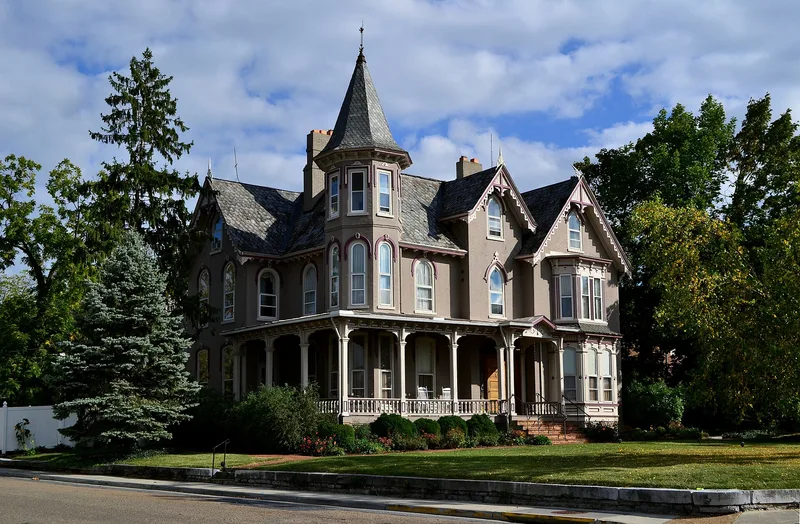
Located on a generous lawn at 412 South Main Street in Harrisonburg, this brick house was completed in 1890 for Joshua Wilton. A Canadian who arrived in Harrisonburg in 1865, Wilton started a foundry, then opened a hardware store in 1868, and later served as a bank president, hospital trustee and city council member. The two-and-one-half-story house has a multi-gable roof, a three-story octagonal turret, projecting gabled pavilions, bay windows, pointed-arch windows with hood molds, decorative bargeboards and an original slate-shingle roof. Inside, a curved open-well stair, Ionic column openings and ornate mantels reflect the period's taste for display. The house is considered significant as a fine example of Victorian architecture whose eclectic details, drawn from pattern-book elements, express the owner's own preferences. Later used as a fraternity house, it was acquired by owners intending to restore it. A small outbuilding from the same period survives at the rear.
Significance in brief: The nomination presents the house as one of the Valley's notable examples of late 19th-century Victorian domestic architecture. Its eclectic design reflects the taste, wealth and position of its builder, a prominent Harrisonburg hardware merchant and civic leader. Such showy residences along main streets have become vulnerable to demolition.
Machine-generated summary. This summary was generated by a language model from the official nomination document and has not been reviewed line by line by an editor. It may contain errors. Check the source document before relying on any detail. Source: nomination document (PDF) · National Archives catalog entry. NRHP reference 79003281, listed May 24, 1979. Summary generated October 2026 (model claude-sonnet-5-5, prompt v1.0-2026-10-29, confidence medium).
Key facts
| Address | 412 S. Main St., Harrisonburg (Independent City) |
|---|---|
| County | Harrisonburg |
| Listed | May 24, 1979 |
| Reference number | 79003281 |
| Resource type | Building |
| Period of significance | 1890 |
| Architect / builder | Joshua Wilton (builder) |
| Architectural style | Late 19th-century Victorian, eclectic |
| Areas of significance | Architecture |
| Level of significance | State |
| Status (as stated in the nomination) | Marked as unoccupied and in good condition on the form. It was most recently a fraternity house and had been purchased by owners who hoped to restore it; the owners' grant request describes broken windows, a leaking roof and damaged heating and plumbing. |
| Acreage | 0.9 |
| Within district | Harrisonburg Downtown Historic District |
| Coordinates | 38.44519, -78.86949 (NPS GIS) |
What listing means for this property
National Register listing is honorary for a privately owned home: it does not by itself restrict what an owner may do with their own money, and it does not require public access. Restrictions come from local landmark or historic-district ordinances, which are separate (how they differ).
Owner-occupied houses are not eligible for the 20% federal rehabilitation tax credit, which applies to income-producing buildings, but many states offer credits for homeowners. Listing also opens the door to preservation easements and to buying a plaque. Start with what listing means for homeowners, renovating a listed house and selling one.
Noted as vacant in the nomination. Nomination documents can be decades old; current status may differ. If you are considering buying an empty listed property, read the due-diligence checklist.
General information, not legal or tax advice. Rules change; confirm with your State Historic Preservation Office or a qualified adviser.
Sources and further reading
- National Park Service, National Register of Historic Places database (snapshot May 2026), reference 79003281.
- Nomination form (PDF, National Archives) — catalog entry
- Wikipedia article (used for cross-checking only; text not reproduced here)
- Wikidata Q15229767
- This listing as JSON
Last updated October 2026. Found an error? See the editorial policy for how to report it.