Hickory Hill
).jpg)
Why it's listed
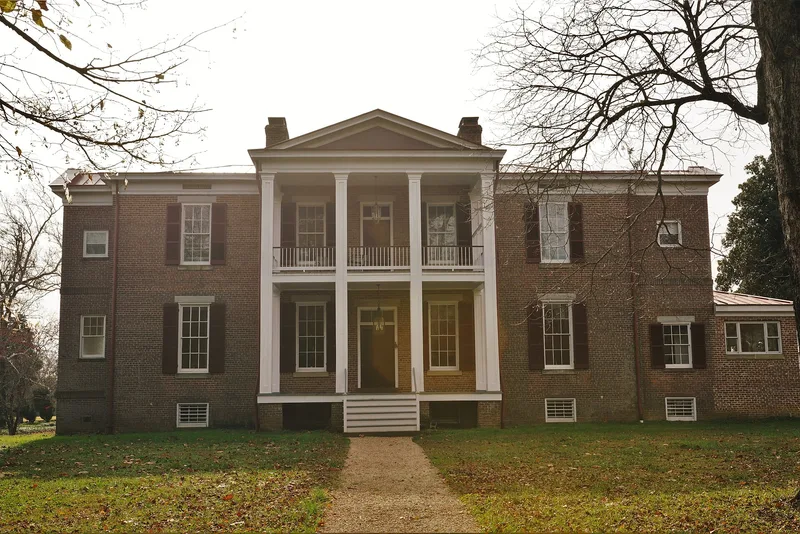
Hickory Hill is a Hanover County plantation near Ashland, Virginia, centered on a large brick house set within a four-acre pleasure garden. The present house dates to 1875 and follows the lines of an 1820 frame house that burned. It has a five-bay facade with a pedimented portico, a brick wing from 1857, and bath projections added in 1915. Many 1820s outbuildings survive, including a kitchen, office, smokehouse, and an early dovecote. The gardens include a geometric box garden, a tree box walk, and a path of rose arbors. The Wickham family founded the plantation after Robert Carter of Shirley gave land to his daughter and her husband in 1820. Williams Carter Wickham, a state legislator, Confederate general, and railroad president, lived here. During the Civil War, Federal troops occupied the plantation, and General Rooney Lee was captured here in 1863 while recovering from wounds. The nominated area covers 640 of the plantation's 3,362 acres.
Significance in brief: The plantation was established by the Wickham family, who have held it for five generations, and is tied to Virginia social and military history. Its gardens are described as among the largest and best preserved examples of ante-bellum landscaping in the state. Williams Carter Wickham, a Confederate general and later railroad president, lived here, and Civil War fighting and the capture of Rooney Lee occurred on the property.
Machine-generated summary. This summary was generated by a language model from the official nomination document and has not been reviewed line by line by an editor. It may contain errors. Check the source document before relying on any detail. Source: nomination document (PDF) · National Archives catalog entry. NRHP reference 74002121, listed November 21, 1974. Summary generated October 2026 (model claude-sonnet-5-5, prompt v1.0-2026-10-29, confidence high).
Key facts
| Address | E of Ashland off VA 646, Ashland |
|---|---|
| County | Hanover County |
| Listed | November 21, 1974 |
| Reference number | 74002121 |
| Resource type | Building |
| Period of significance | 19th Century (specific dates 1820, 1875) |
| Areas of significance | Landscape Architecture, Military, Architecture, Social History |
| Level of significance | State |
| Status (as stated in the nomination) | Condition marked good, altered, original site; the form checks occupied and use as a private residence. The gardens are noted as not maintained with the perfection of former times. |
| Acreage | 640 |
| Coordinates | 37.77466, -77.41267 (NPS GIS) |
What listing means for this property
National Register listing is honorary: it recognises significance and does not restrict what a private owner may do without federal money or permits. It unlocks the 20% federal rehabilitation tax credit for income-producing buildings, state credits in many states, and Section 106 review when federal agencies are involved. See what listing means in practice.
General information, not legal or tax advice. Rules change; confirm with your State Historic Preservation Office or a qualified adviser.
Sources and further reading
- National Park Service, National Register of Historic Places database (snapshot May 2026), reference 74002121.
- Nomination form (PDF, National Archives) — catalog entry
- Wikipedia article (used for cross-checking only; text not reproduced here)
- Wikidata Q5751203
- This listing as JSON
Last updated October 2026. Found an error? See the editorial policy for how to report it.