Newport Historic District
Also known as: 35-151
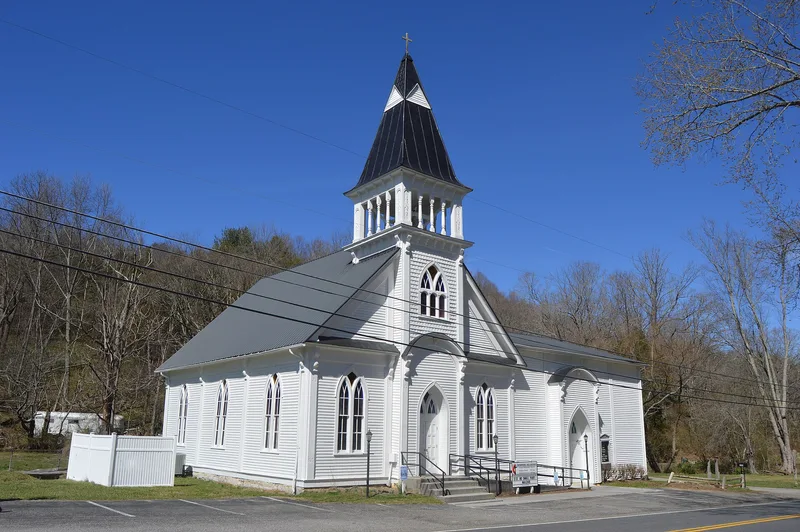

Why it's listed
Newport is a small rural village in the narrow Greenbrier Branch valley of eastern Giles County, Virginia, laid out along two intersecting roads. It began as an agricultural processing center with a tanyard, grist mills and an oil mill, then became more commercial after the Cumberland Gap Turnpike came through in the 1830s. Taverns, stores, houses and churches followed, and other early roads met at the village crossroads. A fire in 1902 destroyed most commercial buildings on the main street, so many stores date from the following years. The district's 53 contributing resources include I-houses, a board-and-batten cottage, Italianate and Queen Anne stores, a 1927 Beaux-Arts bank, a Craftsman service station and the 1872 Newport Woolen Mill, which still holds its belt-and-pulley system and machinery. Concrete sidewalks from the 1930s and mature street trees add to the setting. The district was recognized for its commerce, transportation, industry and architecture between 1832 and 1943.
Significance in brief: The district is significant under Criteria A and C for its roles in commerce, transportation, industry and architecture between 1832 and 1943. Newport grew from a mill and tanyard settlement into a commercial crossroads on early turnpikes. Its surviving buildings show a range of nineteenth- and early twentieth-century styles, many rebuilt after a disastrous 1902 fire.
Machine-generated summary. This summary was generated by a language model from the official nomination document and has not been reviewed line by line by an editor. It may contain errors. Check the source document before relying on any detail. Source: nomination document (PDF) · National Archives catalog entry. NRHP reference 94000059, listed February 25, 1994. Summary generated October 2026 (model claude-sonnet-5-5, prompt v1.0-2026-10-29, confidence medium).
Key facts
| Address | Area surrounding Greenbriar Branch Rd. and VA 42, Newport |
|---|---|
| County | Giles County |
| Listed | February 25, 1994 |
| Reference number | 94000059 |
| Resource type | District |
| Period of significance | 1832 - 1943 |
| Architect / builder | UNKNOWN |
| Architectural style | Greek Revival, Gothic Revival, Italianate, Queen Anne, Stick/Eastlake, Beaux Arts Classicism, Bungalow/Craftsman |
| Criteria |
|
| Areas of significance | Commerce, Transportation, Industry, Architecture |
| Level of significance | Local |
| Status (as stated in the nomination) | The Newport Woolen Mill is described as threatened by deterioration from water infiltration and deferred maintenance. Current functions include vacant/not in use alongside residential and commercial uses. |
| Acreage | 35 |
| Within district | Greater Newport Rural Historic District |
| Coordinates | 37.29526, -80.49427 (NPS GIS) |
What listing means for this property
This is a historic district. Buildings within its boundary are either contributing (they add to the district's significance) or non-contributing. Owners of contributing income-producing buildings can claim the 20% federal rehabilitation tax credit; homeowners should look at state credits. National Register districts impose no design review by themselves; a local historic district ordinance, if one exists, does (the difference explained).
General information, not legal or tax advice. Rules change; confirm with your State Historic Preservation Office or a qualified adviser.
Sources and further reading
- National Park Service, National Register of Historic Places database (snapshot May 2026), reference 94000059.
- Nomination form (PDF, National Archives) — catalog entry
- Wikipedia article (used for cross-checking only; text not reproduced here)
- Wikidata Q14712959
- This listing as JSON
Last updated October 2026. Found an error? See the editorial policy for how to report it.