Hook-Powell-Moorman Farm
Also known as: VDHR File No. 33-22
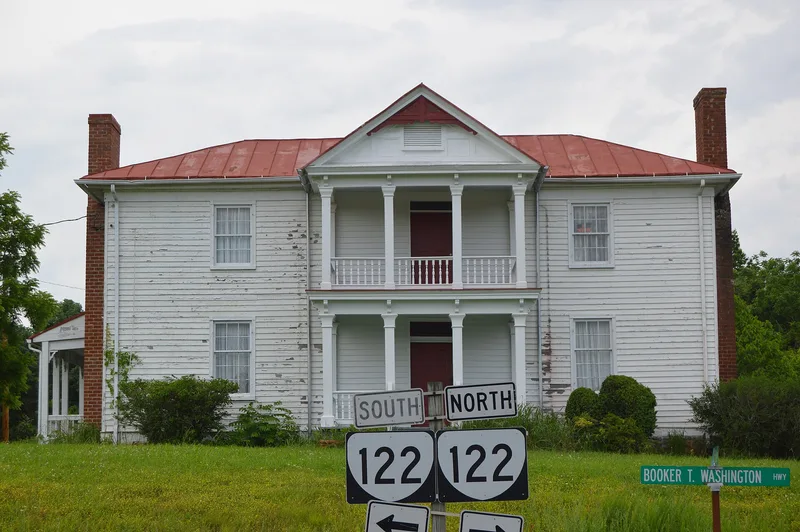

Why it's listed
This farm at Hales Ford, in northeast Franklin County, Virginia, preserves buildings and sites spanning more than a century of use. Its main house is a ca. 1855 Greek Revival farmhouse that incorporates an earlier dwelling. Behind it stands a small frame building with Georgian detailing, identified as the ca. 1784 store of Scottish-born merchant John Hook and later used as a slave quarter. A ca. 1890 office holds the preserved shelves, work table and handwritten notes of Dr. John A. Moorman, who practiced here. Ruins, a spring, an ice pond site and other archaeological features add to the district. Hook built a large business and estate of about 40,000 acres and 110 enslaved people at his death in 1808. The farm was listed for its association with Hook, for the rare surviving store, for the doctor's office, and for its architecture. Its period of significance runs from about 1782 to 1912, the year Moorman died.
Significance in brief: The farm is argued to be significant for commerce through the ca. 1784 John Hook Store, one of only a dozen or so surviving eighteenth-century commercial buildings in Virginia. It is also significant for its link to merchant John Hook (1745-1808), for health and medicine through Dr. John A. Moorman's ca. 1890 office, and for architecture. The nomination argues statewide significance.
Machine-generated summary. This summary was generated by a language model from the official nomination document and has not been reviewed line by line by an editor. It may contain errors. Check the source document before relying on any detail. Source: nomination document (PDF) · National Archives catalog entry. NRHP reference 95000893, listed July 21, 1995. Summary generated October 2026 (model claude-sonnet-5-5, prompt v1.0-2026-10-29, confidence high).
Key facts
| Address | Jct. of VA 122 and VA 950, Hales Ford |
|---|---|
| County | Franklin (city and county) |
| Listed | July 21, 1995 |
| Reference number | 95000893 |
| Resource type | District |
| Period of significance | ca. 1782-1912 |
| Architectural style | Georgian; Greek Revival |
| Criteria |
|
| Areas of significance | Architecture, Commerce, Health/Medicine |
| Level of significance | State |
| Status (as stated in the nomination) | Current function is listed as vacant on the form; former uses included a single dwelling, department store and health care clinic. |
| Acreage | 60 |
| Coordinates | 37.13892, -79.67998 (NPS GIS) |
What listing means for this property
This is a historic district. Buildings within its boundary are either contributing (they add to the district's significance) or non-contributing. Owners of contributing income-producing buildings can claim the 20% federal rehabilitation tax credit; homeowners should look at state credits. National Register districts impose no design review by themselves; a local historic district ordinance, if one exists, does (the difference explained).
Noted as vacant in the nomination. Nomination documents can be decades old; current status may differ. If you are considering buying an empty listed property, read the due-diligence checklist.
General information, not legal or tax advice. Rules change; confirm with your State Historic Preservation Office or a qualified adviser.
Sources and further reading
- National Park Service, National Register of Historic Places database (snapshot May 2026), reference 95000893.
- Nomination form (PDF, National Archives) — catalog entry
- Wikipedia article (used for cross-checking only; text not reproduced here)
- Wikidata Q14712570
- This listing as JSON
Last updated October 2026. Found an error? See the editorial policy for how to report it.