Eckington School

Why it's listed
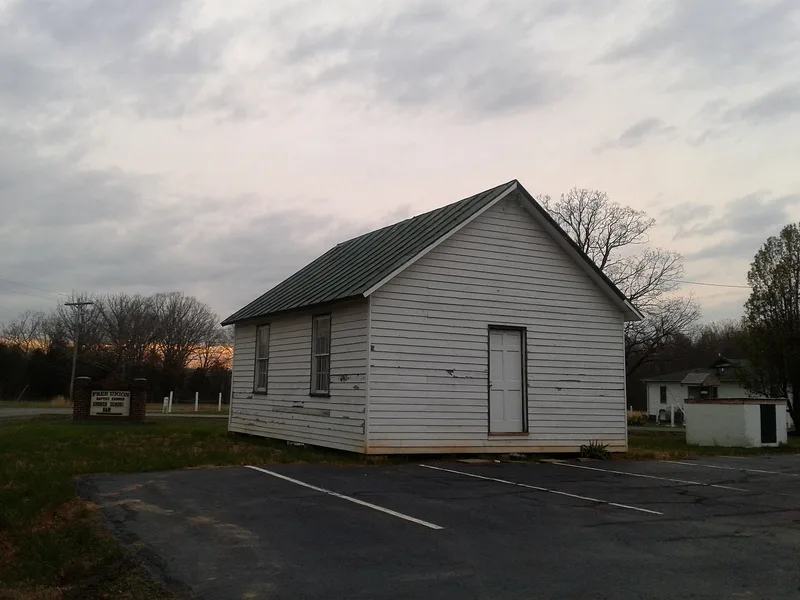
Eckington School is a small, one-story frame schoolhouse in south-central Culpeper County, Virginia. Built in 1895, it served Black children from the nearby communities of Eckington and Poplar Ridge, and it is also known as Poplar Ridge School. The building measures 20 by 26 feet, is weatherboarded, rests on low stone piers and has a standing seam metal roof. Inside, the walls and ceiling are beaded pine boards and the floor is oak. Its windows are unusual because both the top and bottom sash can be opened. Classes ended in 1941, when Culpeper County consolidated its public schools. The building then served as a church hall for the neighboring Free Union Baptist Church, which received it in 1990, and a rear shed room was added around 1950. It is considered significant as the only surviving one-room public school for Black students in the county that remains in its original location and appearance, and as a reminder of rural Black education and segregated schooling in Virginia.
Significance in brief: The nomination argues it is the only one-room public school for Black students in Culpeper County still standing in its original location and keeping its original appearance. It is a rare example of a nearly vanished ungraded schoolhouse type. It also reflects the importance of education in the rural Black community after the Civil War and the history of education in Virginia.
Machine-generated summary. This summary was generated by a language model from the official nomination document and has not been reviewed line by line by an editor. It may contain errors. Check the source document before relying on any detail. Source: nomination document (PDF) · National Archives catalog entry. NRHP reference 01000154, listed February 16, 2001. Summary generated October 2026 (model claude-sonnet-5-5, prompt v1.0-2026-10-29, confidence high).
Key facts
| Address | Jct. of VA 658 and VA 661, Culpeper |
|---|---|
| County | Culpeper County |
| Listed | February 16, 2001 |
| Reference number | 01000154 |
| Resource type | Building |
| Period of significance | 1895 to 1941 |
| Architect / builder | Unknown |
| Architectural style | No style (vernacular) |
| Criteria |
|
| Areas of significance | Education, Black |
| Level of significance | Local |
| Status (as stated in the nomination) | Listed function is vacant/not in use; the form says the building has been used for storage since 1987, and the owning church plans to stabilize and restore it for historical exhibits. |
| Acreage | 0.6 |
| Coordinates | 38.40382, -77.92397 (NPS GIS) |
What listing means for this property
For a publicly owned building or structure, listing mainly matters when federal funds, permits or licences are involved: projects then go through Section 106 review so effects on the property are considered. Listing also strengthens applications for preservation grants and, for leased income-producing uses, can enable the federal rehabilitation tax credit.
Noted as vacant in the nomination. Nomination documents can be decades old; current status may differ. If you are considering buying an empty listed property, read the due-diligence checklist.
General information, not legal or tax advice. Rules change; confirm with your State Historic Preservation Office or a qualified adviser.
Sources and further reading
- National Park Service, National Register of Historic Places database (snapshot May 2026), reference 01000154.
- Nomination form (PDF, National Archives) — catalog entry
- Wikipedia article (used for cross-checking only; text not reproduced here)
- Wikidata Q14712265
- This listing as JSON
Last updated October 2026. Found an error? See the editorial policy for how to report it.