Mulberry Hill

Why it's listed
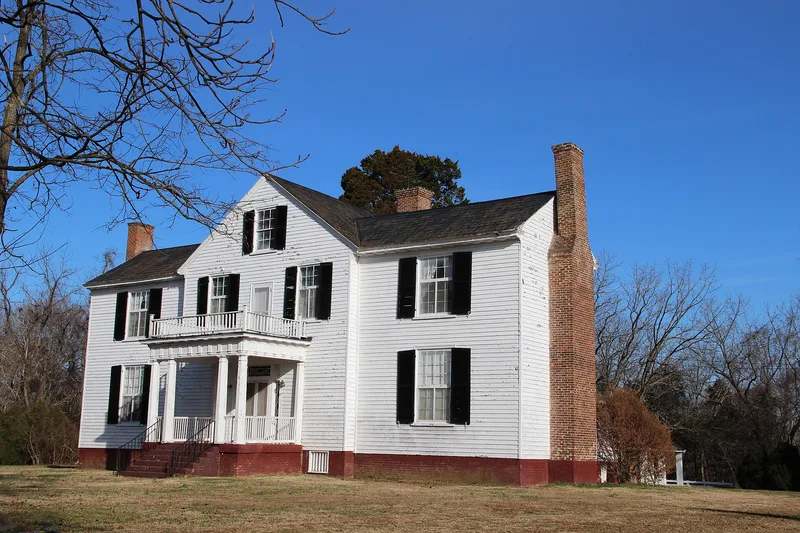
Mulberry Hill is a plantation house near Randolph in Charlotte County, Virginia, where two building periods meet. The eighteenth-century center section has a gable-end front pavilion, an interior-end chimney, and a Georgian stair with vase-and-column balusters. Mid-nineteenth-century two-story wings with Doric cornices and exterior chimneys flank it, and a Doric porch shelters the entrance. The grounds keep an unusually complete group of early outbuildings, including Judge Paul Carrington's small frame office, a brick kitchen, a spinning house, a dairy, a smokehouse, a privy and servants' quarters. A formal garden and Carrington's grave are also on the property. Carrington, born in 1733, served as King's Attorney, a Burgess and a member of the committee that framed the Virginia Declaration of Rights. He later sat on the General Court and the Court of Appeals, and helped found Hampden-Sydney College. After his death the estate passed to his son Robert, then in 1830 to Clement Carrington, whose descendants kept it.
Significance in brief: It was the home plantation of Paul Carrington, a jurist and leader of the Independence movement in Virginia, who served on the General Court and the Court of Appeals. The house blends Georgian and Greek Revival work, and the property keeps an unusually complete set of early outbuildings.
Machine-generated summary. This summary was generated by a language model from the official nomination document and has not been reviewed line by line by an editor. It may contain errors. Check the source document before relying on any detail. Source: nomination document (PDF) · National Archives catalog entry. NRHP reference 73002001, listed March 20, 1973. Summary generated October 2026 (model claude-sonnet-5-5, prompt v1.0-2026-10-29, confidence high).
Key facts
| Address | N of Randolph on VA 641, Randolph |
|---|---|
| County | Charlotte County |
| Listed | March 20, 1973 |
| Reference number | 73002001 |
| Resource type | Building |
| Period of significance | 18th and 19th centuries |
| Architectural style | Georgian center section with Greek Revival additions |
| Areas of significance | Law, Architecture |
| Level of significance | State |
| Status (as stated in the nomination) | Listed as in good condition, unaltered, on its original site, and occupied as a private residence. Outbuildings are in various stages of preservation. |
| Acreage | 40 |
| Coordinates | 36.90820, -78.69654 (NPS GIS) |
What listing means for this property
National Register listing is honorary: it recognises significance and does not restrict what a private owner may do without federal money or permits. It unlocks the 20% federal rehabilitation tax credit for income-producing buildings, state credits in many states, and Section 106 review when federal agencies are involved. See what listing means in practice.
General information, not legal or tax advice. Rules change; confirm with your State Historic Preservation Office or a qualified adviser.
Sources and further reading
- National Park Service, National Register of Historic Places database (snapshot May 2026), reference 73002001.
- Nomination form (PDF, National Archives) — catalog entry
- Wikipedia article (used for cross-checking only; text not reproduced here)
- Wikidata Q14712933
- This listing as JSON
Last updated October 2026. Found an error? See the editorial policy for how to report it.