Buckingham Courthouse Historic District

The pin is a point inside the NPS boundary polygon, not a surveyed location.
Why it's listed
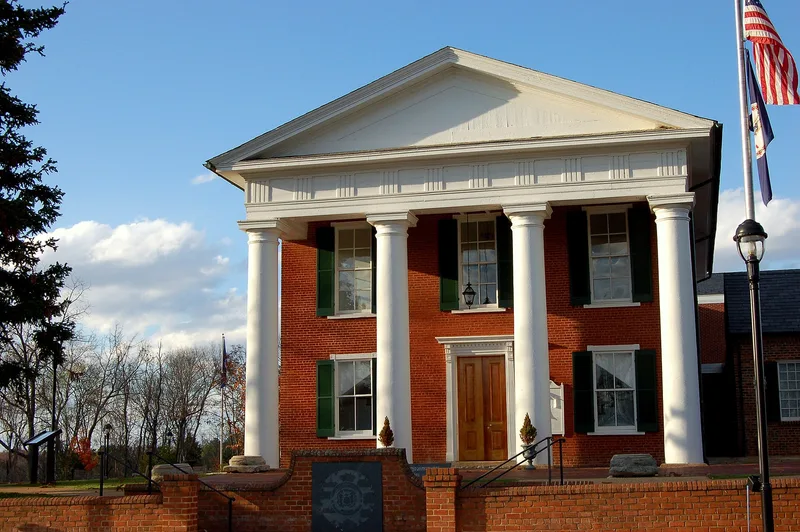
Buckingham Court House is a small Virginia village strung along Route 60 on a ridge between Bryant Creek and the Slate River. Its center is a courthouse square with a two-story temple-form courthouse and a Doric portico. The present building replaced an 1823 courthouse, designed by Thomas Jefferson at the request of building committee member Charles Yancey, which an arsonist destroyed in 1869. Some of its column capitals and bases remain on the grounds. Around the square and along the highway are early-nineteenth century brick taverns, an inn shaped like an H, dwellings such as Rose Terrace with Flemish bond brickwork, and the circa 1830 Trinity Presbyterian Church, whose portico reflects Jefferson's courthouse. Nearly every building has slate shingles. The district was recognized as a well preserved example of an early-nineteenth century courthouse village, despite losses and highway traffic. A Confederate monument in the square honors local men killed in the Civil War, and Robert E. Lee passed through after Appomattox.
Significance in brief: The village is described as a well preserved, picturesque Piedmont courthouse community that keeps its complex of court buildings, taverns and early-nineteenth century dwellings. Its courthouse replaced a Thomas Jefferson-designed building of 1823 that burned in 1869, and the nearby Trinity Presbyterian Church echoes that design. The brickwork is unusually fine, and the village has Civil War associations, including Robert E. Lee's stay nearby after the surrender.
Machine-generated summary. This summary was generated by a language model from the official nomination document and has not been reviewed line by line by an editor. It may contain errors. Check the source document before relying on any detail. Source: nomination document (PDF) · National Archives catalog entry. NRHP reference 69000225, listed November 12, 1969. Summary generated October 2026 (model claude-sonnet-5-5, prompt v1.0-2026-10-29, confidence medium).
Key facts
| Address | Both sides of U.S. 60, Buckingham |
|---|---|
| County | Buckingham County |
| Listed | November 12, 1969 |
| Reference number | 69000225 |
| Resource type | District |
| Period of significance | 19th Century |
| Architect / builder | Thomas Jefferson (designer of the original 1823 courthouse, destroyed by fire in 1869) |
| Architectural style | Temple-form courthouse with Doric portico; Roman Revival church; early-nineteenth century brick buildings |
| Areas of significance | Community Planning and Development, Art, Architecture |
| Level of significance | State |
| Status (as stated in the nomination) | Condition is marked deteriorated on the form, though the text calls the village well preserved. Some significant structures have been lost, and heavy highway traffic has marred the square. |
| Coordinates | 37.55172, -78.55159 (NPS GIS) |
What listing means for this property
This is a historic district. Buildings within its boundary are either contributing (they add to the district's significance) or non-contributing. Owners of contributing income-producing buildings can claim the 20% federal rehabilitation tax credit; homeowners should look at state credits. National Register districts impose no design review by themselves; a local historic district ordinance, if one exists, does (the difference explained).
General information, not legal or tax advice. Rules change; confirm with your State Historic Preservation Office or a qualified adviser.
Sources and further reading
- National Park Service, National Register of Historic Places database (snapshot May 2026), reference 69000225.
- Nomination form (PDF, National Archives) — catalog entry
- Wikipedia article (used for cross-checking only; text not reproduced here)
- Wikidata Q14712100
- This listing as JSON
Last updated October 2026. Found an error? See the editorial policy for how to report it.