Olive Branch Missionary Baptist Church
Also known as: Olive Branch Baptist Church; Vdhr 009-0135

Why it's listed
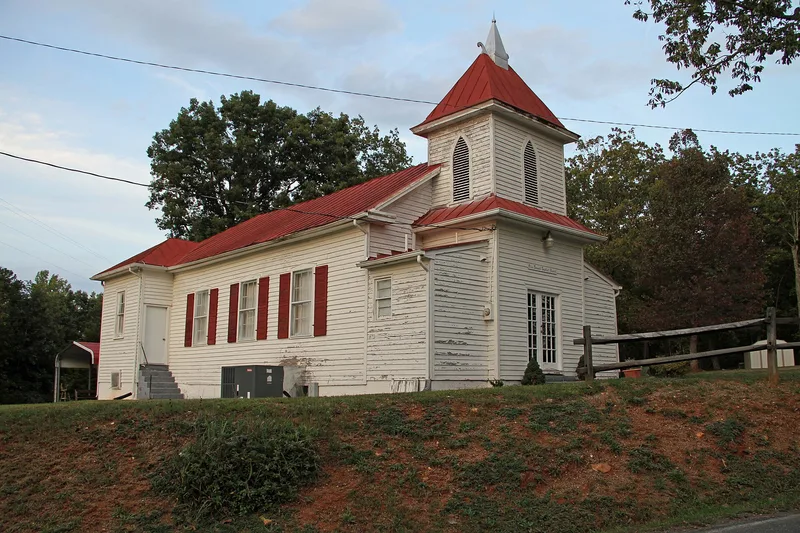
Olive Branch Missionary Baptist Church is a small white frame church with a cemetery, set at a rural crossroads near Moneta in southern Bedford County, Virginia. Trustees received the land by deed in March 1896, and the front-gabled building went up that year. A bell tower with Gothic lancet openings and a tin fixture at its peak is its most distinctive feature. Around 1920 a rear transept was added, giving the building a T-shape. The church drew its members from local farming families and followed the black Baptist tradition of home missionary work and Sunday school instruction. It also served as the home church of Rev. Noel C. Taylor, who later became Roanoke's first black mayor and returned to preach at annual homecomings. The congregation dwindled, and the building was leased to another congregation by 1993, but it remains in religious use. It is recognized for its role in the religious and ethnic history of the county's African American community.
Significance in brief: The church is significant under Criterion A in the areas of Religion and Ethnic History: African-American. It is associated with the black Baptist missionary movement and the history of Bedford County's African American community. It was the home church of Rev. Noel C. Taylor, later Roanoke's first black mayor.
Machine-generated summary. This summary was generated by a language model from the official nomination document and has not been reviewed line by line by an editor. It may contain errors. Check the source document before relying on any detail. Source: nomination document (PDF) · National Archives catalog entry. NRHP reference 07000392, listed May 4, 2007. Summary generated October 2026 (model claude-sonnet-5-5, prompt v1.0-2026-10-29, confidence high).
Key facts
| Address | 5982 Joppa Mill Rd., Moneta |
|---|---|
| County | Bedford (city and county) |
| Listed | May 4, 2007 |
| Reference number | 07000392 |
| Resource type | Building |
| Period of significance | 1896-1957 |
| Architect / builder | unknown |
| Architectural style | Gothic Revival |
| Criteria |
|
| Areas of significance | Religion, Black |
| Level of significance | Local |
| Status (as stated in the nomination) | Still used as a church; services are held on the first and third Sundays of the month, and the interior is described as in good condition. |
| Acreage | 1.2 |
| Coordinates | 37.24855, -79.62584 (NPS GIS) |
What listing means for this property
Religious properties are listed for their architectural or historical significance, not their religious use. Listing is honorary and does not restrict the congregation's use of the building. The federal rehabilitation credit is generally unavailable unless part of the building is income-producing; some state programmes and preservation grants do cover religious buildings. Federal funding or permits trigger Section 106 review.
General information, not legal or tax advice. Rules change; confirm with your State Historic Preservation Office or a qualified adviser.
Sources and further reading
- National Park Service, National Register of Historic Places database (snapshot May 2026), reference 07000392.
- Nomination form (PDF, National Archives) — catalog entry
- Wikipedia article (used for cross-checking only; text not reproduced here)
- Wikidata Q7087138
- This listing as JSON
Last updated October 2026. Found an error? See the editorial policy for how to report it.