Town of Potomac
Also known as: DHR File No. 100-136

Why it's listed
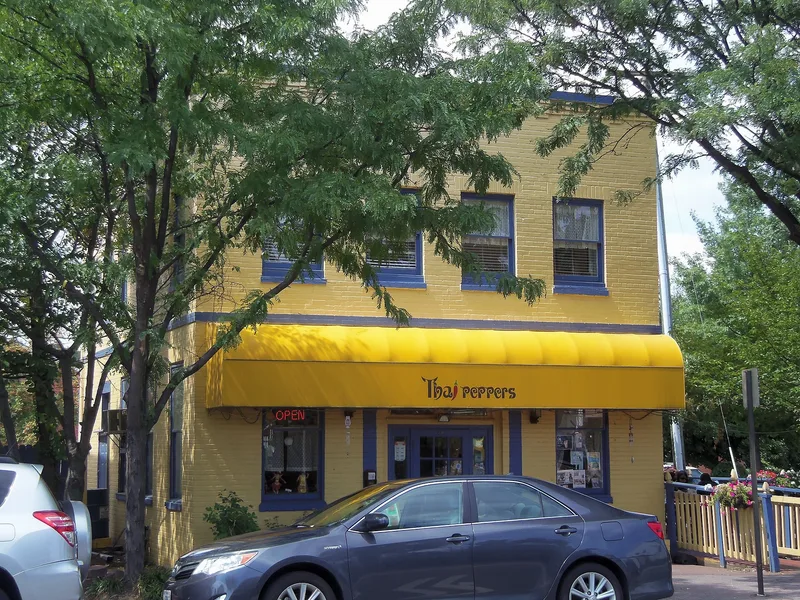
Once an incorporated town, Potomac is now a neighborhood district in Alexandria, Virginia, made up of the St. Elmo, Del Ray, Abingdon and Hume subdivisions. Developers Wood and Harmon of Ohio platted St. Elmo and Del Ray in 1894, and the town was incorporated in 1908 and annexed by Alexandria in 1930. Residents commuted by rail and electric trolley to Washington, D.C., or worked at the Potomac Yards rail facility. The district retains its original grid, deep lots, large trees and 15-foot setbacks. Housing includes Foursquares, Bungalows, Colonial Revival, Queen Anne and Folk Victorian examples, plus Sears mail-order houses and a portable chapel shipped from Michigan. Mount Vernon Avenue holds two-story brick buildings with shops below and apartments above, some in Art Deco and Moderne styles. The 1926 combined Fire Station and Town Hall, designed by Francis Drischler, is the most important civic landmark. The district was listed for its suburban planning, transportation history and architecture.
Significance in brief: The nomination argues the district is a well-preserved late-19th and early-20th-century suburban development shaped by railroad and trolley commuting to Washington, D.C. It also cites the original grid plan and 15-foot setbacks, a wide Mount Vernon Avenue laid out for grand houses, and a wide variety of domestic, commercial, religious and civic architecture. The work of many local builders and architects, and mail-order buildings, add to its interest.
Machine-generated summary. This summary was generated by a language model from the official nomination document and has not been reviewed line by line by an editor. It may contain errors. Check the source document before relying on any detail. Source: nomination document (PDF) · National Archives catalog entry. NRHP reference 92001186, listed September 10, 1992. Summary generated October 2026 (model claude-sonnet-5-5, prompt v1.0-2026-10-29, confidence medium).
Key facts
| Address | Roughly bounded by Commonwealth Ave., US 1, E. Bellefonte Ave. and Ashby Ave., Alexandria (Independent City) |
|---|---|
| County | Alexandria |
| Listed | September 10, 1992 |
| Reference number | 92001186 |
| Resource type | District |
| Architect / builder | Drischler, Francis - Architect; Raymond, Newman H. - architect/builder; Glassman, Jacob - builder; Horton, Fred W.; Poladian, J. H.; Saulsbury, P.A.; Hamaker, Kent; and others listed |
| Architectural style | Queen Anne, Colonial Revival, Bungalow/Craftsman, Folk Victorian, Tudor Revival, Mediterranean Revival, Moderne, Art Deco |
| Criteria |
|
| Areas of significance | Community Planning and Development, Transportation, Politics/Government, Architecture, Social History |
| Level of significance | Local |
| Status (as stated in the nomination) | Still largely intact; many houses remain in residential use, Mount Vernon Avenue is now mostly commercial, and the railroad right-of-way has become a linear park. The former bank at 2401 Mount Vernon Avenue is described as vacant. |
| Acreage | 184 |
| Coordinates | 38.82868, -77.05273 (NPS GIS) |
What listing means for this property
This is a historic district. Buildings within its boundary are either contributing (they add to the district's significance) or non-contributing. Owners of contributing income-producing buildings can claim the 20% federal rehabilitation tax credit; homeowners should look at state credits. National Register districts impose no design review by themselves; a local historic district ordinance, if one exists, does (the difference explained).
General information, not legal or tax advice. Rules change; confirm with your State Historic Preservation Office or a qualified adviser.
Sources and further reading
- National Park Service, National Register of Historic Places database (snapshot May 2026), reference 92001186.
- Nomination form (PDF, National Archives) — catalog entry
- Wikipedia article (used for cross-checking only; text not reproduced here)
- Wikidata Q7235028
- This listing as JSON
Last updated October 2026. Found an error? See the editorial policy for how to report it.