Bruin's Slave Jail
Also known as: 100-47

Why it's listed
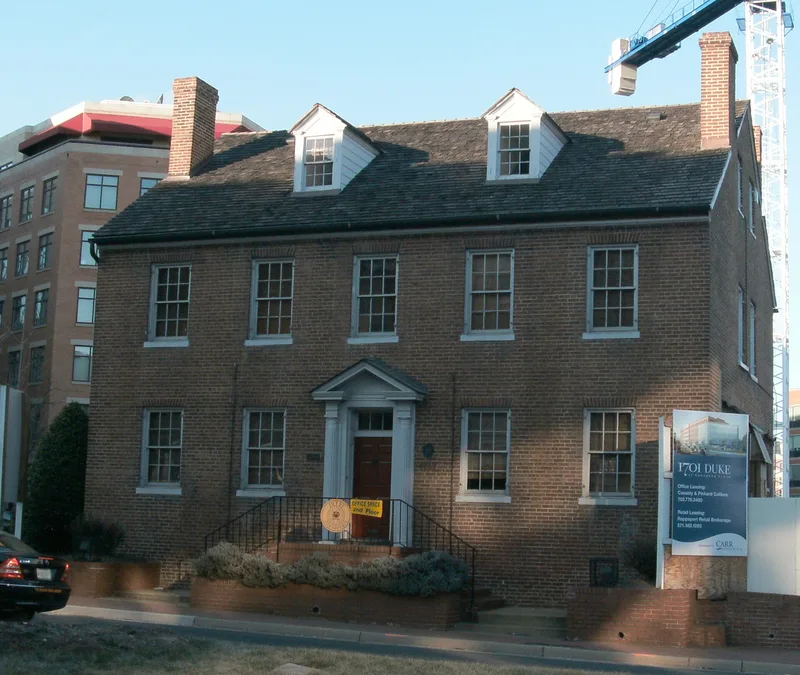
Built around 1819 for John Longden, this two-and-one-half-story brick house at 1707 Duke Street in Alexandria is a Federal-style survivor of the former West End village. It has a five-bay front, a double-pile center-hall plan, a gable roof and slender end chimneys. Later changes include Tuscan pilasters added to the entry in 1930, a cellar dug in 1931, and Victorian-era woodwork. In 1844 slave dealer Joseph Bruin bought the property and used it as a holding facility for enslaved people awaiting sale. Harriet Beecher Stowe cited the jail about twenty times in The Key to Uncle Tom's Cabin, including the story of the Edmondson family. Between 1862 and 1865, while Bruin was imprisoned, the building served as the Fairfax County courthouse under the Restored Government of Virginia. It is considered an uncommon local example of a five-bay Federal dwelling and a unique surviving slave jail in the United States.
Significance in brief: From 1844 the house was used by slave dealer Joseph Bruin as a holding facility or "slave jail" for enslaved people awaiting sale, and Harriet Beecher Stowe referred to it about twenty times in The Key to Uncle Tom's Cabin. It also served as the Fairfax County courthouse under the Restored Government of Virginia from 1862 to 1865. It is an uncommon five-bay Federal dwelling in Alexandria and retains fabric reflecting its use as a slave jail.
Machine-generated summary. This summary was generated by a language model from the official nomination document and has not been reviewed line by line by an editor. It may contain errors. Check the source document before relying on any detail. Source: nomination document (PDF) · National Archives catalog entry. NRHP reference 00000890, listed August 14, 2000. Summary generated October 2026 (model claude-sonnet-5-5, prompt v1.0-2026-10-29, confidence medium).
Key facts
| Address | 1707 Duke St., Alexandria (Independent City) |
|---|---|
| County | Alexandria |
| Listed | August 14, 2000 |
| Reference number | 00000890 |
| Resource type | Building |
| Period of significance | 1819-1865 |
| Architectural style | Early Republic: Federal |
| Criteria |
|
| Areas of significance | Commerce, Politics/Government, Black, Architecture |
| Level of significance | National |
| Status (as stated in the nomination) | Current functions are listed as commerce/trade: business; the building has been altered over time, including a 1931 cellar excavation and twentieth-century attic living space. |
| Acreage | 0.9 |
| Coordinates | 38.80436, -77.05864 (NPS GIS) |
What listing means for this property
For a publicly owned building or structure, listing mainly matters when federal funds, permits or licences are involved: projects then go through Section 106 review so effects on the property are considered. Listing also strengthens applications for preservation grants and, for leased income-producing uses, can enable the federal rehabilitation tax credit.
General information, not legal or tax advice. Rules change; confirm with your State Historic Preservation Office or a qualified adviser.
Sources and further reading
- National Park Service, National Register of Historic Places database (snapshot May 2026), reference 00000890.
- Nomination form (PDF, National Archives) — catalog entry
- Wikipedia article (used for cross-checking only; text not reproduced here)
- Wikidata Q4978706
- This listing as JSON
Last updated October 2026. Found an error? See the editorial policy for how to report it.