Dimmitt, John J., House
Also known as: Site No. 166
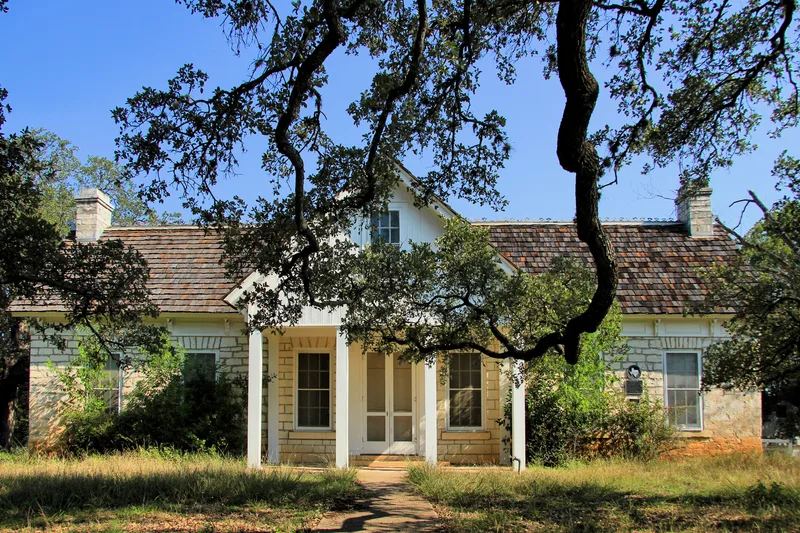

Why it's listed
Set back about 500 feet from West University (Highway 29) in Georgetown, this 1-1/2 story limestone house dates to about 1870. It is a center-passage dwelling of cut-ashlar local stone, with a large side-gabled wood-shingle roof, box eaves with jig-sawn brackets, corbeled chimneys and double wooden doors flanked by 6/6 windows. A gable-front portico was added in 1948. The house sits among live oaks near the San Gabriel River, on about six acres, with a noncontributing garage to the northwest. It was the home of John J. Dimmitt, who settled in Georgetown in the 1860s and built substantial livestock holdings. He became a leading citizen during the 1870s and 1880s, is believed to have helped organize Georgetown College and attract Southwestern University, invested in the short-lived Georgetown Railroad Company, and donated 200 acres to the Texas Chautauqua Assembly. These ties to local commerce and community life are the basis for its listing.
Significance in brief: The house is nominated under Criterion B for its association with John J. Dimmitt, a leading Georgetown citizen of the 1870s and 1880s. He was active in commerce and social/humanitarian causes, including early railroad investment, support for Georgetown College and Southwestern University, and a land donation to the Texas Chautauqua Assembly. It is also an early local example of the center-passage form.
Machine-generated summary. This summary was generated by a language model from the official nomination document and has not been reviewed line by line by an editor. It may contain errors. Check the source document before relying on any detail. Source: nomination document (PDF) · National Archives catalog entry. NRHP reference 96000076, listed February 16, 1996. Summary generated October 2026 (model claude-sonnet-5-5, prompt v1.0-2026-10-29, confidence high).
Key facts
| Address | W. University (TX 29) 0.5 mi. W of jct. with Austin Hwy., Georgetown |
|---|---|
| County | Williamson County |
| Listed | February 16, 1996 |
| Reference number | 96000076 |
| Resource type | Building |
| Period of significance | ca. 1870 - 1884 |
| Architect / builder | unknown |
| Architectural style | Vernacular center-passage |
| Criteria |
|
| Areas of significance | Commerce, Social History, Other |
| Level of significance | Local |
| Status (as stated in the nomination) | Still in use as a single dwelling; a gable-front portico was added in 1948 and the form states the house retains a significant part of its integrity. |
| Acreage | 6 |
| Coordinates | 30.63479, -97.68677 (NPS GIS) |
What listing means for this property
National Register listing is honorary for a privately owned home: it does not by itself restrict what an owner may do with their own money, and it does not require public access. Restrictions come from local landmark or historic-district ordinances, which are separate (how they differ).
Owner-occupied houses are not eligible for the 20% federal rehabilitation tax credit, which applies to income-producing buildings, but many states offer credits for homeowners. Listing also opens the door to preservation easements and to buying a plaque. Start with what listing means for homeowners, renovating a listed house and selling one.
General information, not legal or tax advice. Rules change; confirm with your State Historic Preservation Office or a qualified adviser.
Sources and further reading
- National Park Service, National Register of Historic Places database (snapshot May 2026), reference 96000076.
- Nomination form (PDF, National Archives) — catalog entry
- Wikidata Q110002556
- This listing as JSON
Last updated October 2026. Found an error? See the editorial policy for how to report it.