George Washington Carver Library

Why it's listed
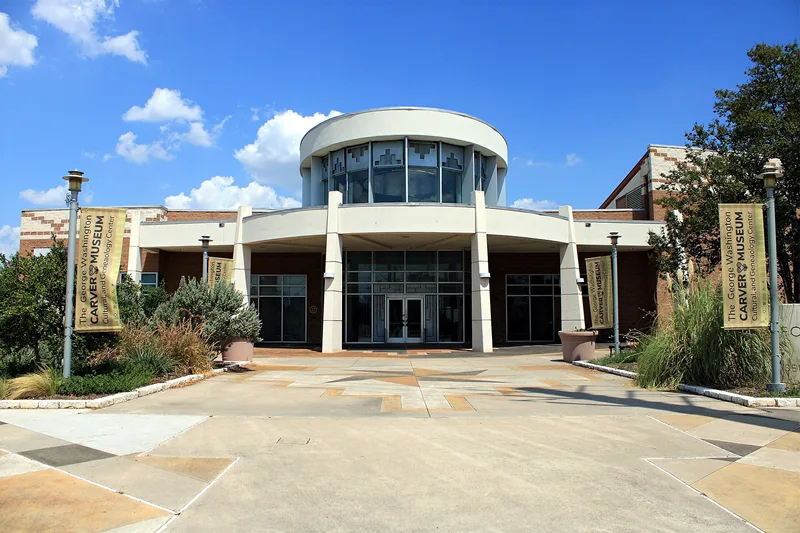
Originally built in 1926 at Ninth and Guadalupe streets as Austin's first public library, this small wood-framed building was moved in 1933 to 1165 Angelina Street in east Austin and covered with beige brick veneer. It then opened as the city's first branch library for African Americans, serving a neighborhood shaped by segregation policies. The library was renamed for George Washington Carver in 1945 and served Black residents exclusively until the city council desegregated the library system in December 1951. It remained an important cultural center for the community, and in 1980 it became the George Washington Carver Museum, the first African American neighborhood museum in Texas. The 1,800-square-foot building is a simple Colonial Revival design with a symmetrical facade, central fanlight door with sidelights, hipped roof and cupola. Its exterior remains largely intact, while the interior has been renovated. It was recognized for its role in Black ethnic heritage and for its architecture at the local level.
Significance in brief: The building served Austin's Black community as its first branch library during segregation, from 1933 until the city library system was desegregated in 1951. It later became the first African American neighborhood museum in Texas. It also reflects the Colonial Revival style used for public buildings in the 1930s.
Machine-generated summary. This summary was generated by a language model from the official nomination document and has not been reviewed line by line by an editor. It may contain errors. Check the source document before relying on any detail. Source: nomination document (PDF) · National Archives catalog entry. NRHP reference 05000241, listed March 30, 2005. Summary generated October 2026 (model claude-sonnet-5-5, prompt v1.0-2026-10-29, confidence high).
Key facts
| Address | 1165 Angelina St., Austin |
|---|---|
| County | Travis County |
| Listed | March 30, 2005 |
| Reference number | 05000241 |
| Resource type | Building |
| Period of significance | 1933-1955 |
| Architect / builder | Hugo Miller |
| Architectural style | Late 19th and 20th Century Revivals: Colonial Revival |
| Criteria |
|
| Areas of significance | Black, Architecture |
| Level of significance | Local |
| Status (as stated in the nomination) | Now used as the George Washington Carver Museum; exterior retains a high degree of integrity, with alterations mainly to the interior, walkways and entrances. |
| Acreage | 0.9 |
| Coordinates | 30.27176, -97.72470 (NPS GIS) |
What listing means for this property
For a publicly owned building or structure, listing mainly matters when federal funds, permits or licences are involved: projects then go through Section 106 review so effects on the property are considered. Listing also strengthens applications for preservation grants and, for leased income-producing uses, can enable the federal rehabilitation tax credit.
General information, not legal or tax advice. Rules change; confirm with your State Historic Preservation Office or a qualified adviser.
Sources and further reading
- National Park Service, National Register of Historic Places database (snapshot May 2026), reference 05000241.
- Nomination form (PDF, National Archives) — catalog entry
- Wikipedia article (used for cross-checking only; text not reproduced here)
- Wikidata Q5545947
- This listing as JSON
Last updated October 2026. Found an error? See the editorial policy for how to report it.