Deep Eddy Bathing Beach
Also known as: Deep Eddy Pool; Eilers Park

Why it's listed
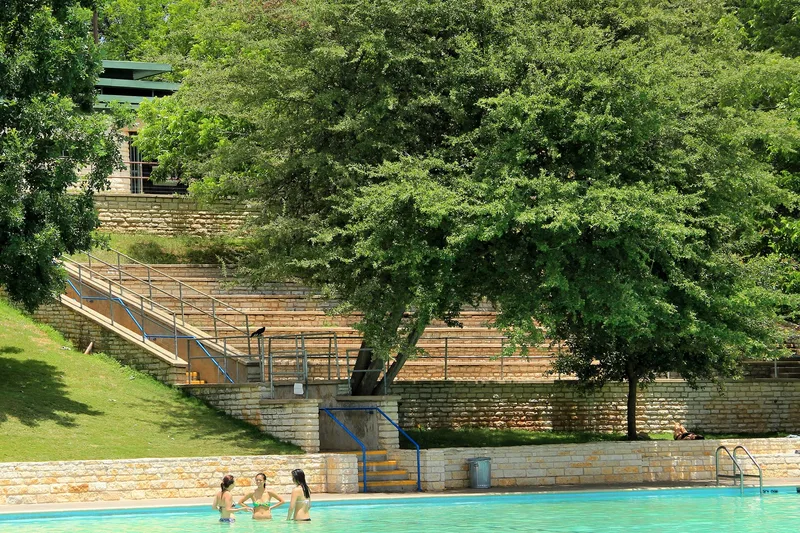
Deep Eddy Bathing Beach sits on a bend of the Colorado River in Austin, Texas. It began in 1902, when Mary and Henry Johnson opened a swimming and camping area on their father's land at the end of a streetcar line. A.J. Eilers bought it in 1915 and had a concrete pool built, open by summer 1916. Manager George Rowley added movies, diving acts and other entertainment. The City of Austin bought the property during the Depression. After a flood destroyed the wooden buildings, the city used Works Progress Administration funds to build a limestone bathhouse in 1935, designed by local architects Dan Driscoll and Delmar Groos. Its simple rustic design, open-air dressing rooms and multi-tiered pagoda-like metal roof follow National Park Service park-building trends. The 204-by-99.5-foot pool, fed by un-chlorinated spring water, remains essentially unchanged, and the site keeps a high degree of integrity. It is listed for its recreation history and its New Deal-era architecture.
Significance in brief: The nomination finds local significance under Criterion A for the site's long history as an Austin recreation area, beginning in 1902. It also finds significance under Criterion C for the 1935 bathhouse, described as an excellent example of New Deal-era rustic park architecture built with Works Progress Administration funds.
Machine-generated summary. This summary was generated by a language model from the official nomination document and has not been reviewed line by line by an editor. It may contain errors. Check the source document before relying on any detail. Source: nomination document (PDF) · National Archives catalog entry. NRHP reference 03000560, listed June 23, 2003. Summary generated October 2026 (model claude-sonnet-5-5, prompt v1.0-2026-10-29, confidence high).
Key facts
| Address | 301 Quarry St., Austin |
|---|---|
| County | Travis County |
| Listed | June 23, 2003 |
| Reference number | 03000560 |
| Resource type | District |
| Period of significance | 1902-1953 |
| Architect / builder | Dan Driscoll and Delmar Groos, architects (bathhouse) |
| Architectural style | Other: National Park Service Rustic |
| Criteria |
|
| Areas of significance | Entertainment/Recreation, Architecture |
| Level of significance | Local |
| Status (as stated in the nomination) | Still in use as a recreation facility; only the locker rooms and storage area of the bathhouse are currently used, and 1960s additions were recently removed. |
| Acreage | 9 |
| Coordinates | 30.27633, -97.77291 (NPS GIS) |
What listing means for this property
This is a historic district. Buildings within its boundary are either contributing (they add to the district's significance) or non-contributing. Owners of contributing income-producing buildings can claim the 20% federal rehabilitation tax credit; homeowners should look at state credits. National Register districts impose no design review by themselves; a local historic district ordinance, if one exists, does (the difference explained).
General information, not legal or tax advice. Rules change; confirm with your State Historic Preservation Office or a qualified adviser.
Sources and further reading
- National Park Service, National Register of Historic Places database (snapshot May 2026), reference 03000560.
- Nomination form (PDF, National Archives) — catalog entry
- Wikipedia article (used for cross-checking only; text not reproduced here)
- Wikidata Q5250168
- This listing as JSON
Last updated October 2026. Found an error? See the editorial policy for how to report it.