City Cemetery
Also known as: Site #25; Austin City Cemetery; Oakwood Cemetery

Why it's listed
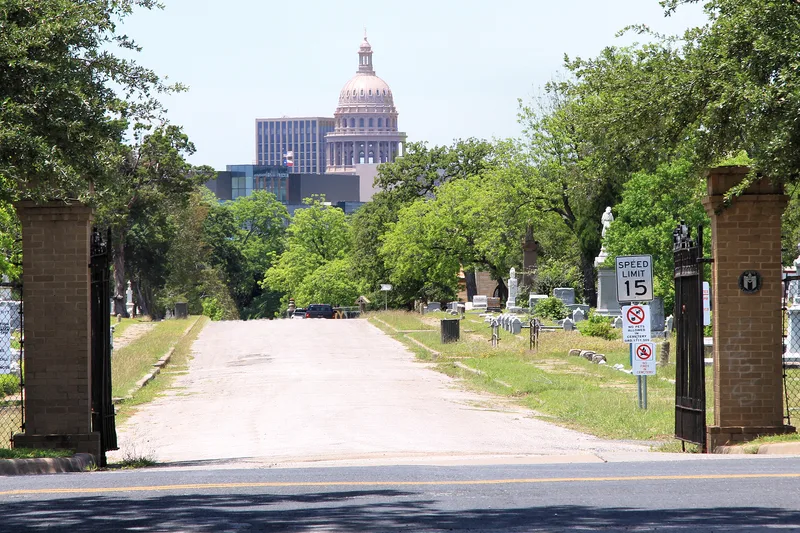
Oakwood Cemetery, also known as City Cemetery, occupies about 34 acres on a hill in East Austin and ranks among the city's earliest burial grounds. The first burial in the area is thought to have taken place in 1839, and in 1856 the Texas Legislature transferred the land to the City of Austin. Mature oaks and cedars shade the grounds, and a high chain-link fence surrounds the original section. The entrance at East 16th and Navasota streets passes between massive rusticated-stone posts with a double wrought-iron gate. Monumental crypts and cenotaphs mark family plots in both the Jewish and non-Jewish areas. Among those buried here are Governor E. M. Pease, Thomas Watt Gregory, and Thomas F. McKinney, along with members of the Zilker, Mayer, Bergstrom and Nalle families. The custodian's office is a one-story, L-shaped Gothic Revival building of rusticated limestone with a crenelated corner tower and pointed-arch openings. Its design and the cemetery's long association with Austin's early leaders support its listing.
Significance in brief: The nomination argues the cemetery is significant as one of Austin's earliest cemeteries and for its Gothic Revival custodian's office, described as one of the finest Gothic Revival structures in the city. It is also the burial place of many pioneers and builders, and it contains notable funerary art. The reviewer recommended acceptance under criteria A and C.
Machine-generated summary. This summary was generated by a language model from the official nomination document and has not been reviewed line by line by an editor. It may contain errors. Check the source document before relying on any detail. Source: nomination document (PDF) · National Archives catalog entry. NRHP reference 85002297, listed September 17, 1985. Summary generated October 2026 (model claude-sonnet-5-5, prompt v1.0-2026-10-29, confidence medium).
Key facts
| Address | 16th & Navasota, Austin |
|---|---|
| County | Travis County |
| Listed | September 17, 1985 |
| Reference number | 85002297 |
| Resource type | District |
| Period of significance | 1800-1899, 1900- |
| Architectural style | Gothic Revival (custodian's office) |
| Criteria |
|
| Areas of significance | Architecture |
| Level of significance | Local |
| Status (as stated in the nomination) | Physical condition is listed as excellent, with no alterations; the property is still used as a cemetery. |
| Acreage | 34 |
| Coordinates | 30.27689, -97.72644 (NPS GIS) |
What listing means for this property
This is a historic district. Buildings within its boundary are either contributing (they add to the district's significance) or non-contributing. Owners of contributing income-producing buildings can claim the 20% federal rehabilitation tax credit; homeowners should look at state credits. National Register districts impose no design review by themselves; a local historic district ordinance, if one exists, does (the difference explained).
General information, not legal or tax advice. Rules change; confirm with your State Historic Preservation Office or a qualified adviser.
Sources and further reading
- National Park Service, National Register of Historic Places database (snapshot May 2026), reference 85002297.
- Nomination form (PDF, National Archives) — catalog entry
- Wikipedia article (used for cross-checking only; text not reproduced here)
- Wikidata Q6350693
- This listing as JSON
Last updated October 2026. Found an error? See the editorial policy for how to report it.