Hutcheson-Smith House

Why it's listed
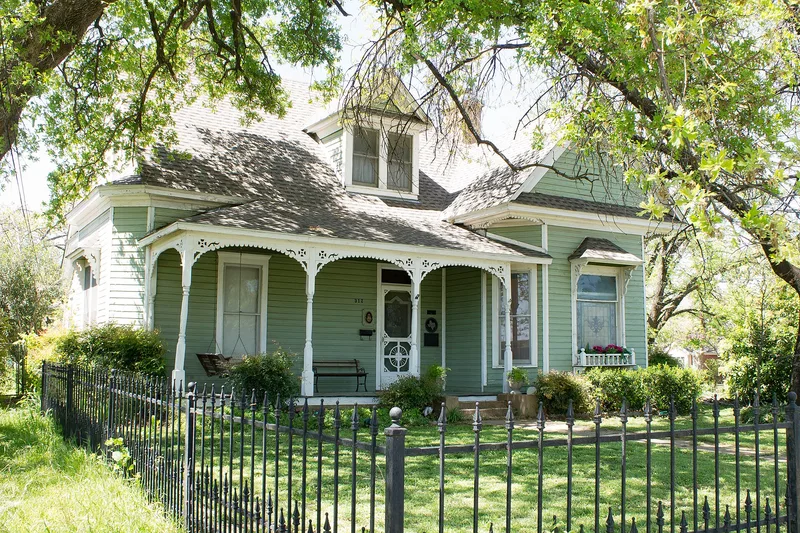
Built about 1896 at 312 North Oak Street in Arlington, this one-and-a-half-story wood-frame house shows Queen Anne and Eastlake influence. It has steep intersecting gables, novelty siding, and a front porch with six turned columns, jigsaw-cut balusters and a scalloped arch. Inside, a wide central hall serves six rooms, with 12-foot ceilings, a mahogany fireplace and original cast-iron door hardware. Additions in the 1920s included dormers and an enclosed rear section. I.L. Hutcheson, a founding officer of the Johnson Station Masonic Lodge, bought the land in 1885 and sold it to his son William in 1896. S.T. Smith and his wife, Sue, bought it in 1919, and the Smith family lived there for decades. The house was recognized as a Recorded Texas Historic Landmark in 1982. It may be the only surviving Queen Anne and Eastlake house in Arlington, a city that changed rapidly after World War II.
Significance in brief: The nomination argues it may be the only surviving example of Queen Anne and Eastlake architecture in Arlington, retaining nearly all its original gingerbread trim. It is also tied to the Hutcheson family, early Arlington settlers, and to the Smith family, known for their educational interests. Few turn-of-the-century buildings survive in the city.
Machine-generated summary. This summary was generated by a language model from the official nomination document and has not been reviewed line by line by an editor. It may contain errors. Check the source document before relying on any detail. Source: nomination document (PDF) · National Archives catalog entry. NRHP reference 84001993, listed August 2, 1984. Summary generated October 2026 (model claude-sonnet-5-5, prompt v1.0-2026-10-29, confidence high).
Key facts
| Address | 312 N. Oak St., Arlington |
|---|---|
| County | Tarrant County |
| Listed | August 2, 1984 |
| Reference number | 84001993 |
| Resource type | Building |
| Period of significance | 1896 |
| Architect / builder | Unknown |
| Architectural style | Queen Anne and Eastlake |
| Areas of significance | Architecture |
| Level of significance | Local |
| Status (as stated in the nomination) | Described as in very good condition and occupied as a private residence at the time of nomination; the house sat vacant after the Smith family era until 1979. |
| Acreage | 0.9 |
| Coordinates | 32.74027, -97.10953 (NPS GIS) |
What listing means for this property
National Register listing is honorary for a privately owned home: it does not by itself restrict what an owner may do with their own money, and it does not require public access. Restrictions come from local landmark or historic-district ordinances, which are separate (how they differ).
Owner-occupied houses are not eligible for the 20% federal rehabilitation tax credit, which applies to income-producing buildings, but many states offer credits for homeowners. Listing also opens the door to preservation easements and to buying a plaque. Start with what listing means for homeowners, renovating a listed house and selling one.
General information, not legal or tax advice. Rules change; confirm with your State Historic Preservation Office or a qualified adviser.
Sources and further reading
- National Park Service, National Register of Historic Places database (snapshot May 2026), reference 84001993.
- Nomination form (PDF, National Archives) — catalog entry
- Wikidata Q107319630
- This listing as JSON
Last updated October 2026. Found an error? See the editorial policy for how to report it.