Cotton Belt Railroad Industrial Historic District

Why it's listed
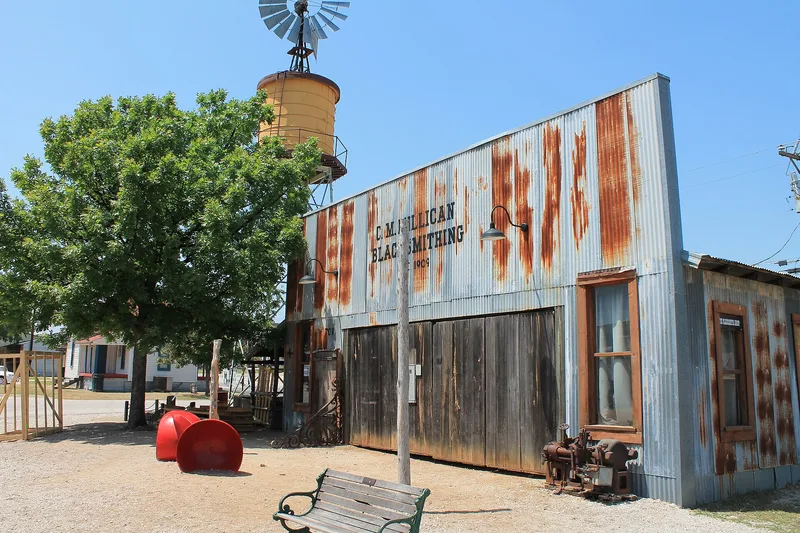
Along the Cotton Belt rail line just south of Grapevine's commercial district, a cluster of railroad and industrial buildings records how the town became a regional shipping point. The district includes a 1888 section house built for a track maintenance foreman, a 1901 depot with segregated waiting rooms, and a 1928 steel plate girder bridge that carries the track over Highway 26. West of Main Street, the Farmers & Merchants Milling Company, later B&D Mills, grew from a 1902 flour mill into a feed manufacturing complex with a grain elevator and concrete silos. South of the tracks, small metal warehouses and machine shops were mostly built by 1948. Rail service let local farmers ship cotton, sweet potatoes, peanuts and poultry feed products to distant markets. The depot and section house were moved close to their original sites and restored. The district is significant for transportation, commerce and vernacular industrial architecture between 1888 and 1956.
Significance in brief: The district reflects Grapevine's growth as a rail-served trade center for an agricultural economy, from the arrival of rail service in 1888 through the postwar growth of agribusiness. It is nominated under Criterion A for Commerce and Transportation and Criterion C for Architecture, at the local level. The railroad buildings represent standard company plans and the industrial buildings are typical vernacular metal structures.
Machine-generated summary. This summary was generated by a language model from the official nomination document and has not been reviewed line by line by an editor. It may contain errors. Check the source document before relying on any detail. Source: nomination document (PDF) · National Archives catalog entry. NRHP reference 97001109, listed September 4, 1997. Summary generated October 2026 (model claude-sonnet-5-5, prompt v1.0-2026-10-29, confidence high).
Key facts
| Address | Along RR tracks, roughly bounded by Hudgins, Dooley, and Dallas Sts., Grapevine |
|---|---|
| County | Tarrant County |
| Listed | September 4, 1997 |
| Reference number | 97001109 |
| Resource type | District |
| Period of significance | 1888-1956 |
| Architect / builder | unknown |
| Architectural style | No style |
| Criteria |
|
| Areas of significance | Architecture, Industry, Transportation |
| Level of significance | Local |
| Status (as stated in the nomination) | Current functions include museum, manufacturing facility and vacant/not in use. The depot and section house were relocated and restored by the Grapevine Heritage Foundation. The mill complex had a fire in 1995 but retains much of its original character. |
| Acreage | 13.7 |
| Coordinates | 32.93354, -97.07837 (NPS GIS) |
What listing means for this property
This is a historic district. Buildings within its boundary are either contributing (they add to the district's significance) or non-contributing. Owners of contributing income-producing buildings can claim the 20% federal rehabilitation tax credit; homeowners should look at state credits. National Register districts impose no design review by themselves; a local historic district ordinance, if one exists, does (the difference explained).
General information, not legal or tax advice. Rules change; confirm with your State Historic Preservation Office or a qualified adviser.
Sources and further reading
- National Park Service, National Register of Historic Places database (snapshot May 2026), reference 97001109.
- Nomination form (PDF, National Archives) — catalog entry
- Wikipedia article (used for cross-checking only; text not reproduced here)
- Wikidata Q14710430
- This listing as JSON
Last updated October 2026. Found an error? See the editorial policy for how to report it.