Cullen, Ezekiel, House

Why it's listed
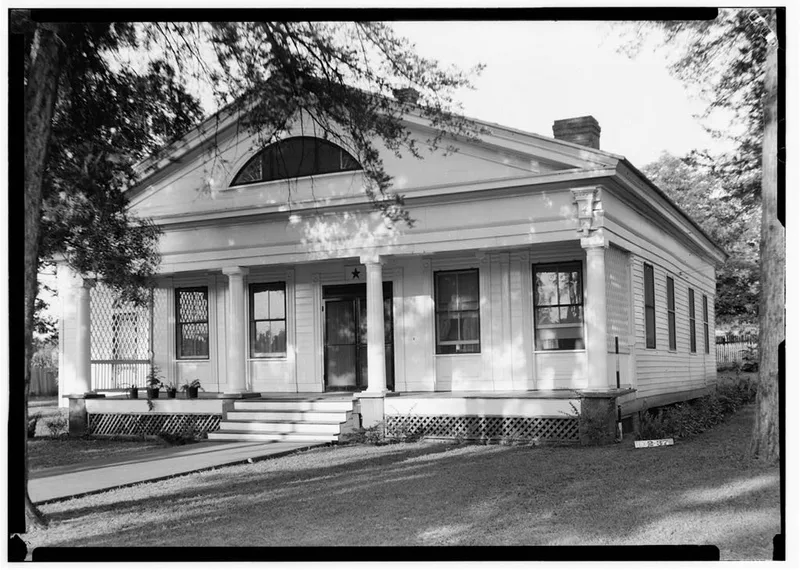
Built in 1839 at 207 South Congress in San Augustine, this one-story frame house is an unusual Texas example of Greek Revival design. Master builder Augustus Phelps gave it a true temple form, with a broad pedimented gable carried on four widely spaced Doric columns. Most Greek Revival houses in Texas were wider than deep, with side gables, but this one is deeper than wide and faces the street with its gable. It has a central hall plan, six rooms on the main level including an attached rear kitchen, and a ballroom in the attic. Ezekiel Wimberly Cullen commissioned it. He came to Texas from Georgia in 1835, served in the army during the siege of Bexar, sat in the Congress of the Republic, became a district judge, and wrote the bill setting aside public lands for education and The University of Texas. The house later passed through several owners until his grandson restored it and presented it to a chapter of the Daughters of the Republic of Texas as a memorial. It was restored in the early 1950s and remains in excellent condition.
Significance in brief: The house is an unusual Texas example of Greek Revival design, with a true temple form in which the gable faces the front and the house is deeper than it is wide. It is also tied to Ezekiel Cullen, a Texas Revolution volunteer, congressman and judge who authored the bill setting aside public lands for education and The University of Texas.
Machine-generated summary. This summary was generated by a language model from the official nomination document and has not been reviewed line by line by an editor. It may contain errors. Check the source document before relying on any detail. Source: nomination document (PDF) · National Archives catalog entry. NRHP reference 71000960, listed June 21, 1971. Summary generated October 2026 (model claude-sonnet-5-5, prompt v1.0-2026-10-29, confidence medium).
Key facts
| Address | 207 S. Congress St., San Augustine |
|---|---|
| County | San Augustine County |
| Listed | June 21, 1971 |
| Reference number | 71000960 |
| Resource type | Building |
| Period of significance | 19th Century (specific date 1839) |
| Architect / builder | Augustus Phelps, master builder |
| Architectural style | Greek Revival (temple form) |
| Areas of significance | Politics/Government, Architecture |
| Level of significance | State |
| Status (as stated in the nomination) | Excellent condition, unaltered, on its original site; restored in the early 1950s and maintained in an excellent state of repair. Used as a museum and listed as occupied. |
| Acreage | 1 |
| Within district | San Augustine Residential Historic District |
| Coordinates | 31.52668, -94.10797 (NPS GIS) |
What listing means for this property
National Register listing is honorary for a privately owned home: it does not by itself restrict what an owner may do with their own money, and it does not require public access. Restrictions come from local landmark or historic-district ordinances, which are separate (how they differ).
Owner-occupied houses are not eligible for the 20% federal rehabilitation tax credit, which applies to income-producing buildings, but many states offer credits for homeowners. Listing also opens the door to preservation easements and to buying a plaque. Start with what listing means for homeowners, renovating a listed house and selling one.
General information, not legal or tax advice. Rules change; confirm with your State Historic Preservation Office or a qualified adviser.
Sources and further reading
- National Park Service, National Register of Historic Places database (snapshot May 2026), reference 71000960.
- Nomination form (PDF, National Archives) — catalog entry
- Wikipedia article (used for cross-checking only; text not reproduced here)
- Wikidata Q107321788
- This listing as JSON
Last updated October 2026. Found an error? See the editorial policy for how to report it.