Texas Technological College Historic District
Also known as: Texas Tech University; See Also: Dairy Barn; Silo

Why it's listed
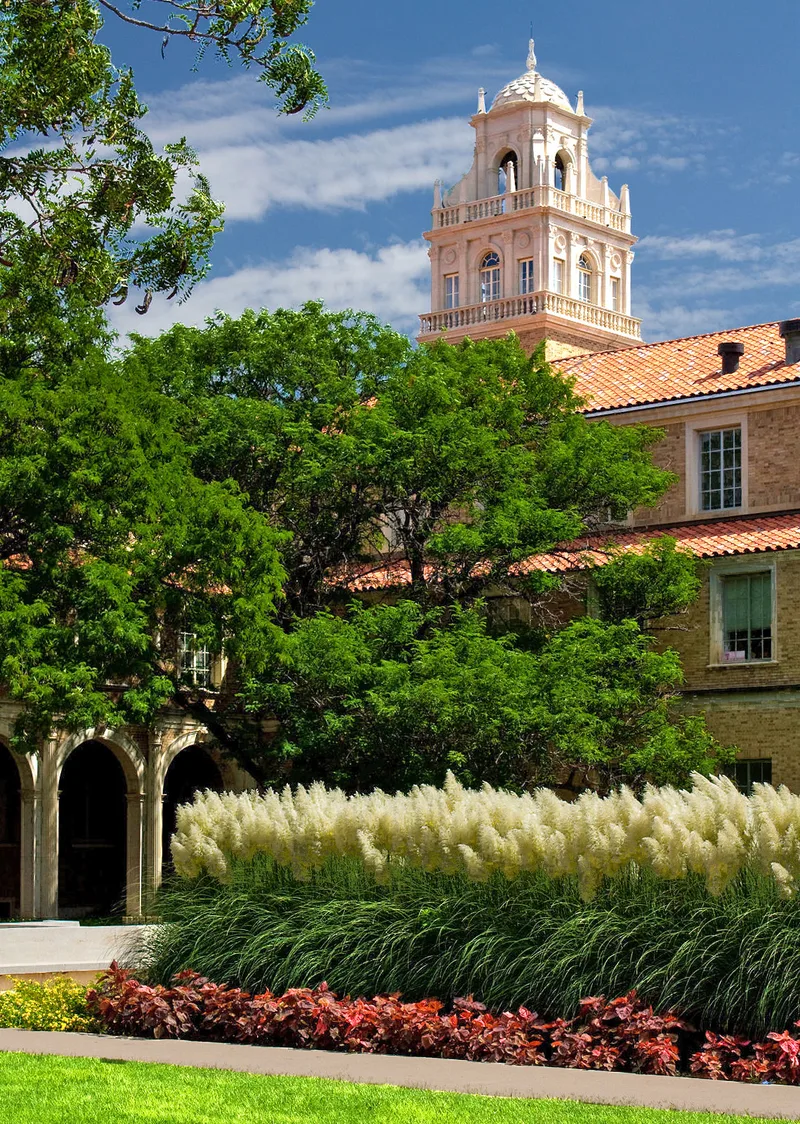
Texas Tech University's historic core in Lubbock covers about 110 acres and preserves the campus built from 1924 to 1951 for Texas Technological College, which the legislature established in 1923. Its layout follows a cruciform plan with a circular common and esplanades, lined with two- and three-story masonry buildings of buff brick, carved stone and ceramic tile roofs. The designs, led by William Ward Watkin and the firm Sanguinet, Staats and Hedrick, especially Wyatt C. Hedrick, apply Spanish Renaissance detailing to collegiate forms. The district holds 32 contributing resources, including the Administration Building, library, museum, dormitories, agricultural buildings and a bronze Will Rogers sculpture, plus four noncontributing ones. It was recognized for its role in meeting West Texas's need for higher education tied to farming and ranching, and for its cohesive Spanish-influenced architecture on a formal Beaux Arts plan. The dairy barn and silo were already individually listed in 1992, and the buildings remain in educational use.
Significance in brief: The nomination argues it is significant under Criterion A in Education for its role in developing higher education to serve West Texas students and the region's agricultural economy. It is also significant under Criterion C in Architecture for a coherent Spanish Renaissance-influenced design by prominent Texas architects, set on a formal campus plan embodying Beaux Arts principles.
Machine-generated summary. This summary was generated by a language model from the official nomination document and has not been reviewed line by line by an editor. It may contain errors. Check the source document before relying on any detail. Source: nomination document (PDF) · National Archives catalog entry. NRHP reference 96000523, listed May 10, 1996. Summary generated October 2026 (model claude-sonnet-5-5, prompt v1.0-2026-10-29, confidence high).
Key facts
| Address | Roughly bounded by 6th St., University Ave., 19th St., and Flint St., Lubbock |
|---|---|
| County | Lubbock County |
| Listed | May 10, 1996 |
| Reference number | 96000523 |
| Resource type | District |
| Period of significance | 1924-1951 |
| Architect / builder | Hedrick, Wyatt C.; Sanguinet, Staats & Hedrick; Watkin, William Ward |
| Architectural style | Late 19th and 20th Century Revival: Spanish Colonial Revival/Mission Revival |
| Criteria |
|
| Areas of significance | Education, Architecture |
| Level of significance | State |
| Status (as stated in the nomination) | All extant resources remain in use for education; the district retains a high degree of integrity and has been well maintained. |
| Acreage | 110 |
| Coordinates | 33.58406, -101.87505 (NPS GIS) |
What listing means for this property
This is a historic district. Buildings within its boundary are either contributing (they add to the district's significance) or non-contributing. Owners of contributing income-producing buildings can claim the 20% federal rehabilitation tax credit; homeowners should look at state credits. National Register districts impose no design review by themselves; a local historic district ordinance, if one exists, does (the difference explained).
General information, not legal or tax advice. Rules change; confirm with your State Historic Preservation Office or a qualified adviser.
Sources and further reading
- National Park Service, National Register of Historic Places database (snapshot May 2026), reference 96000523.
- Nomination form (PDF, National Archives) — catalog entry
- Wikipedia article (used for cross-checking only; text not reproduced here)
- Wikidata Q7708165
- This listing as JSON
Last updated October 2026. Found an error? See the editorial policy for how to report it.