Cleveland-Partlow House
Also known as: Partlow House

Why it's listed
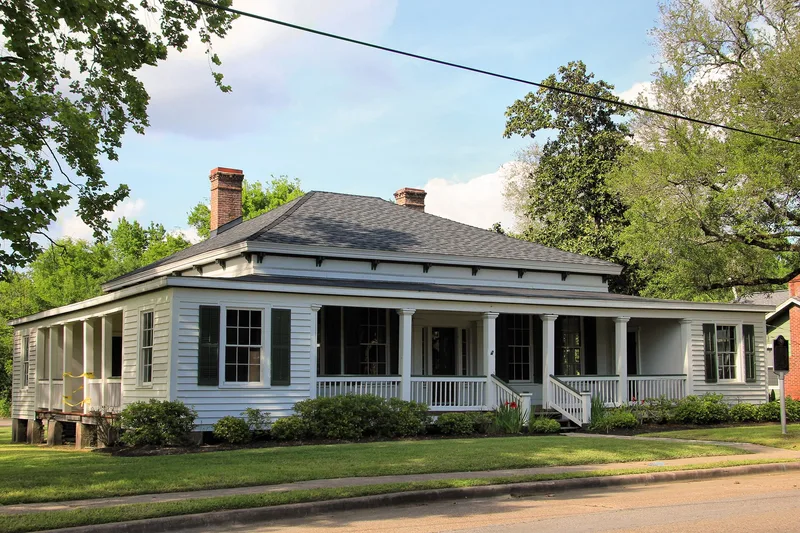
Built around 1860 for Judge C. L. Cleveland, a Kentucky native, this one-story clapboard house at 2131 Grand Avenue in Liberty, Texas, is an unusual late example of Greek Revival design with modest Italianate influence. Its square plan has a central hall and four main rooms, with a pavilion at each corner that was once linked by encircling galleries. The plan resembles Mulberry Plantation in South Carolina, and local tradition says Cleveland added the pavilions for his four sons. The house is the second-oldest still standing in Liberty and was named a Recorded Texas Historic Landmark in 1963. The Partlow family owned it from 1886 until 1983; family members included civic leaders, and Texas Governor Price Daniel was a nephew of the last owner. Later changes include a kitchen addition, the removal of the northwest pavilion, and enclosed side porches. The house was bequeathed to the Texas State Library Commission and is planned to open as a house museum.
Significance in brief: The nomination argues the house is an uncommon example of late Greek Revival architecture in Texas, notable for its four corner pavilions, a plan traced to Mulberry Plantation in South Carolina. It is the second-oldest house still standing in Liberty. It was built by Judge C. L. Cleveland and owned from 1886 to 1983 by the influential Partlow family.
Machine-generated summary. This summary was generated by a language model from the official nomination document and has not been reviewed line by line by an editor. It may contain errors. Check the source document before relying on any detail. Source: nomination document (PDF) · National Archives catalog entry. NRHP reference 84001907, listed February 16, 1984. Summary generated October 2026 (model claude-sonnet-5-5, prompt v1.0-2026-10-29, confidence high).
Key facts
| Address | 2131 Grand Ave., Liberty |
|---|---|
| County | Liberty County |
| Listed | February 16, 1984 |
| Reference number | 84001907 |
| Resource type | Building |
| Period of significance | 1800-1899 |
| Architect / builder | Unknown (built by Judge C. L. Cleveland, per the form) |
| Architectural style | Greek Revival with some Italianate decorative elements |
| Areas of significance | Architecture |
| Level of significance | Local |
| Status (as stated in the nomination) | Described as in good condition and occupied, with no alterations that substantially affect its integrity. It was bequeathed to the Texas State Library Commission in 1983 and is to be opened as a house museum administered by the Libertad Chapter of the D.A.R. |
| Acreage | 0.9 |
| Coordinates | 30.06386, -94.78513 (NPS GIS) |
What listing means for this property
National Register listing is honorary for a privately owned home: it does not by itself restrict what an owner may do with their own money, and it does not require public access. Restrictions come from local landmark or historic-district ordinances, which are separate (how they differ).
Owner-occupied houses are not eligible for the 20% federal rehabilitation tax credit, which applies to income-producing buildings, but many states offer credits for homeowners. Listing also opens the door to preservation easements and to buying a plaque. Start with what listing means for homeowners, renovating a listed house and selling one.
General information, not legal or tax advice. Rules change; confirm with your State Historic Preservation Office or a qualified adviser.
Sources and further reading
- National Park Service, National Register of Historic Places database (snapshot May 2026), reference 84001907.
- Nomination form (PDF, National Archives) — catalog entry
- Wikidata Q107317996
- This listing as JSON
Last updated October 2026. Found an error? See the editorial policy for how to report it.